If you didn’t know any better, you might think that the 1939 version of “The Hunchback of Notre Dame” was filmed on location, I know that’s what I thought at first but that is not the case.
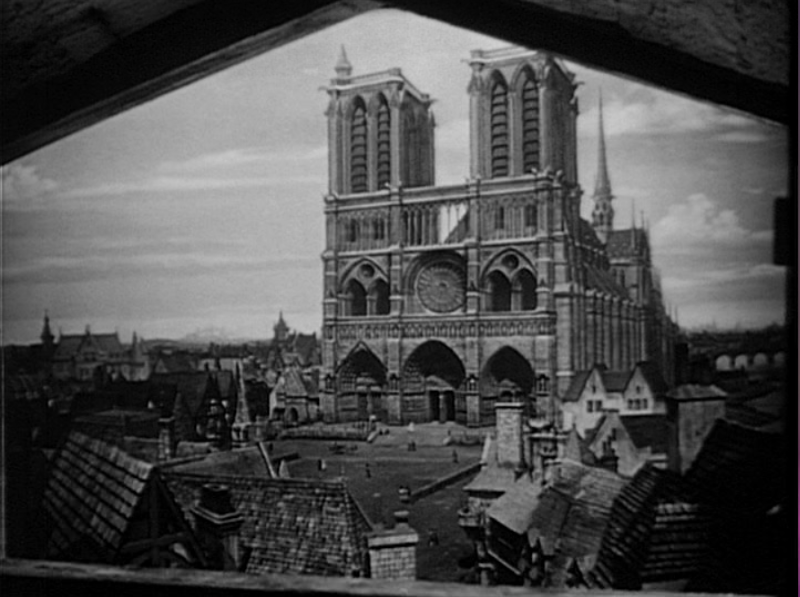
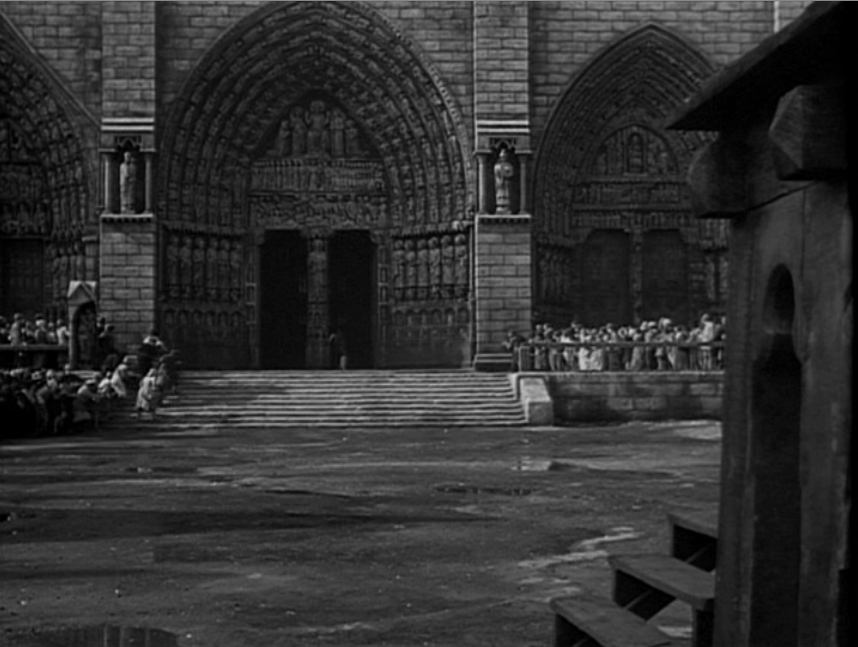
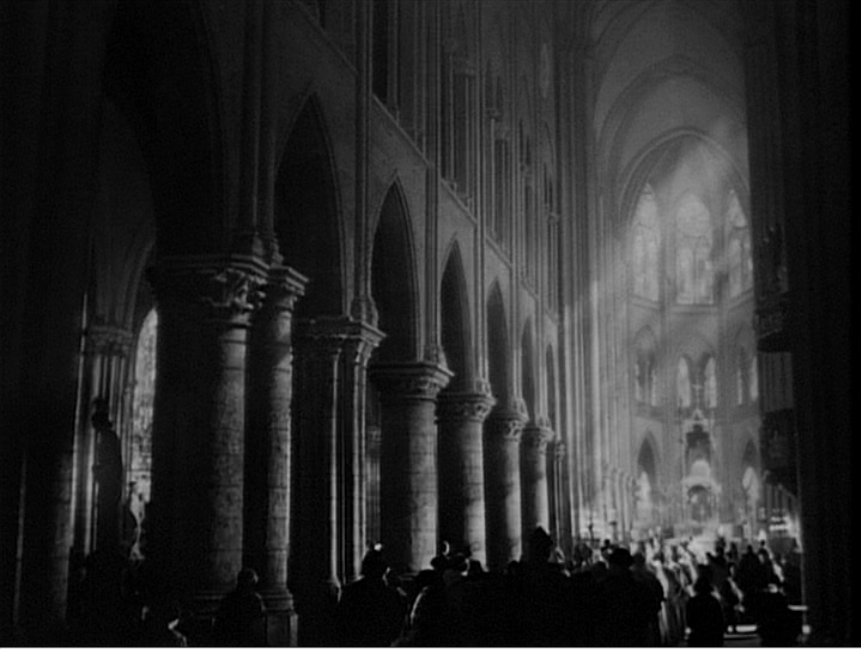
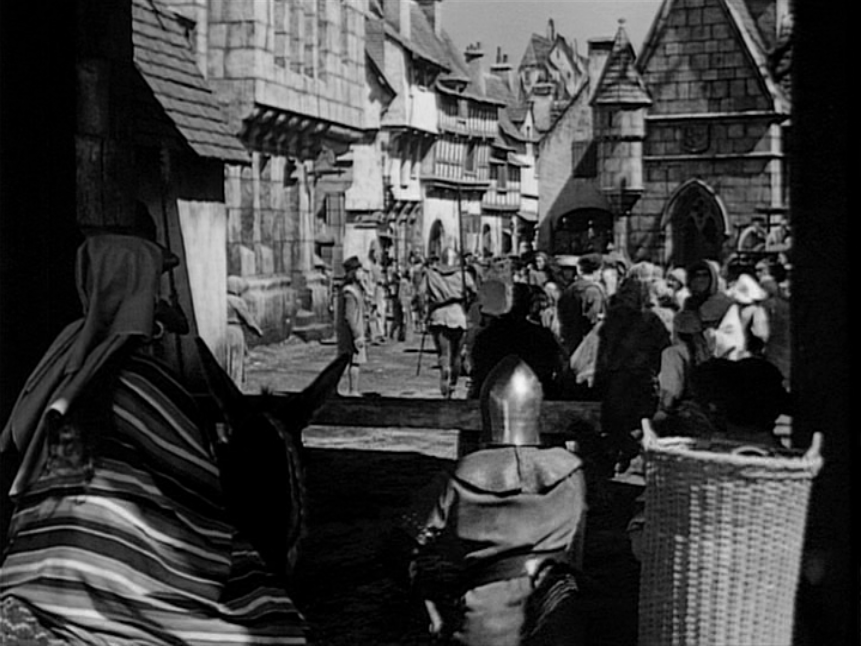
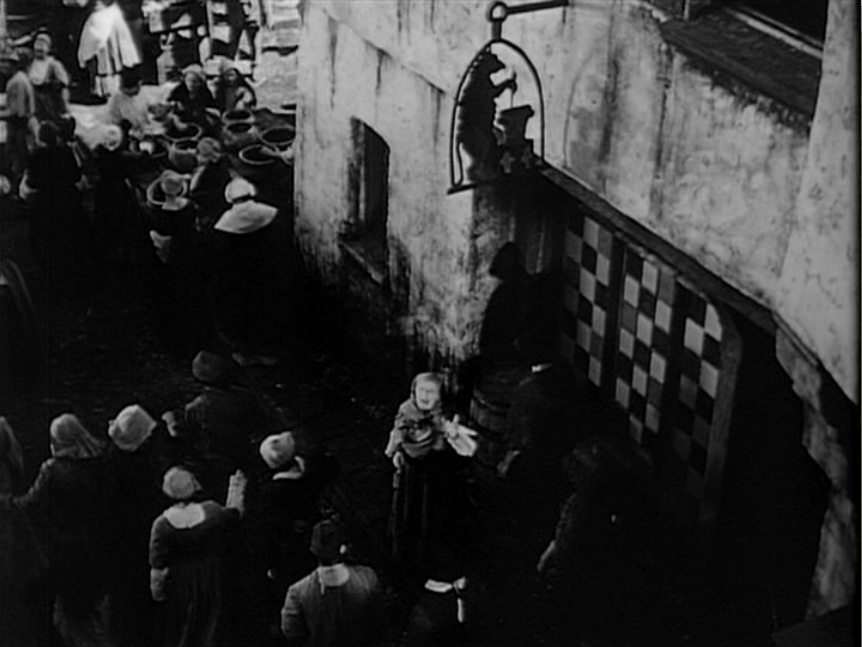
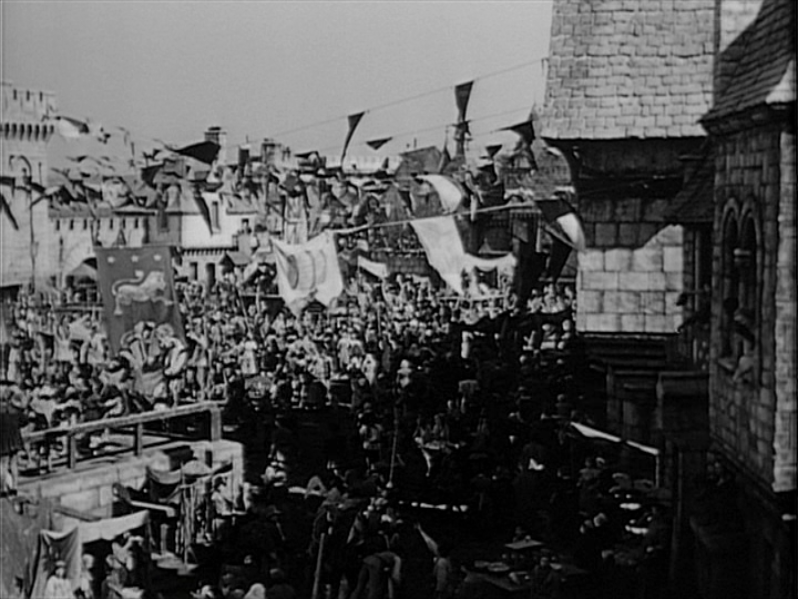
This film was shot completely on set at the RKO ranch in the San Fernando Valley. The sets were designed after a 400 year old wood carving of Paris. The sets are one of the strongest visual aspects of this movie. They transport the viewer to 15th century Paris, with the narrow streets, Notre Dame in all its’ glory, with its’ accurate nave and it’s raised platform complete with stairs, Both the raised platform and the stairs are no longer a part of the actual Notre Dame due to time and erosion. Erosion and structural changes to Notre Dame are some of the reasons why films shouldn’t take too much lead from Notre dame in it’s modern state if their doing a period piece (I’m looking at you here Disney).
Notre Dame
Front of Notre Dame
Facade of Notre Dame
Nave of Notre dame
15th century Parisian Street
Another view of 15th century Parisian Street
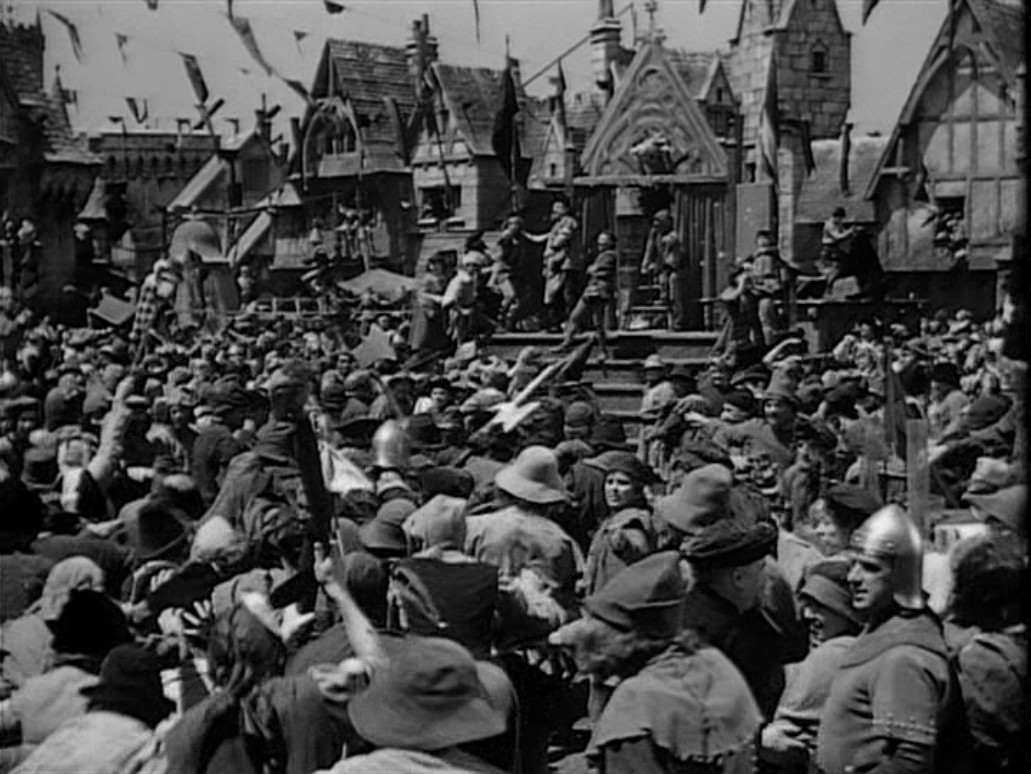
Crowd scene
All the attention to the details of the sets are one of the strongest aspects of the film and this helps keep the film in classic movie nostalgia.
So next up is staging, where things, mainly actors, are position in scenes of a movie. As I was looking at the costumes I noticed something, a lot of the shots are medium or close up unless it was a big epic scene or an establishing shot . This makes it hard to get pictures of costumes but it also makes staging difficult to review. Another factor that makes staging reviewing difficult is that the editing cuts between shots are very frequent, though the cuts are not insane or abnormal. Also other than establishing shot you don’t get a feel for the spaces the characters occupy, not even Notre Dame.
Watching the Play
Gringoire's Play
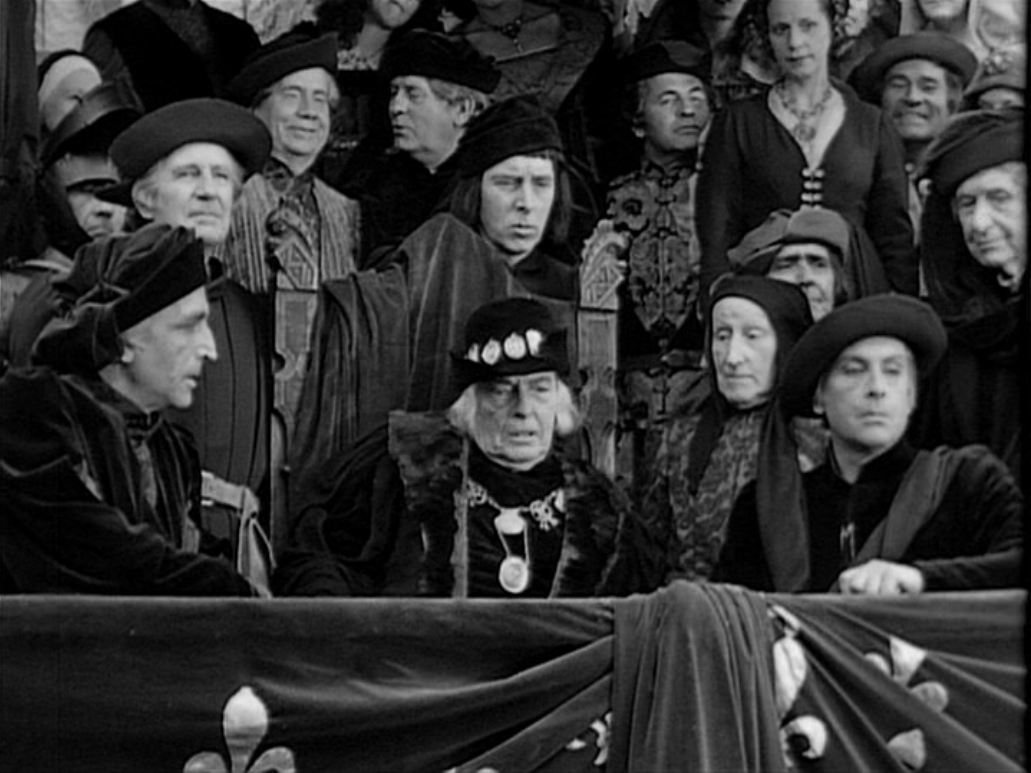
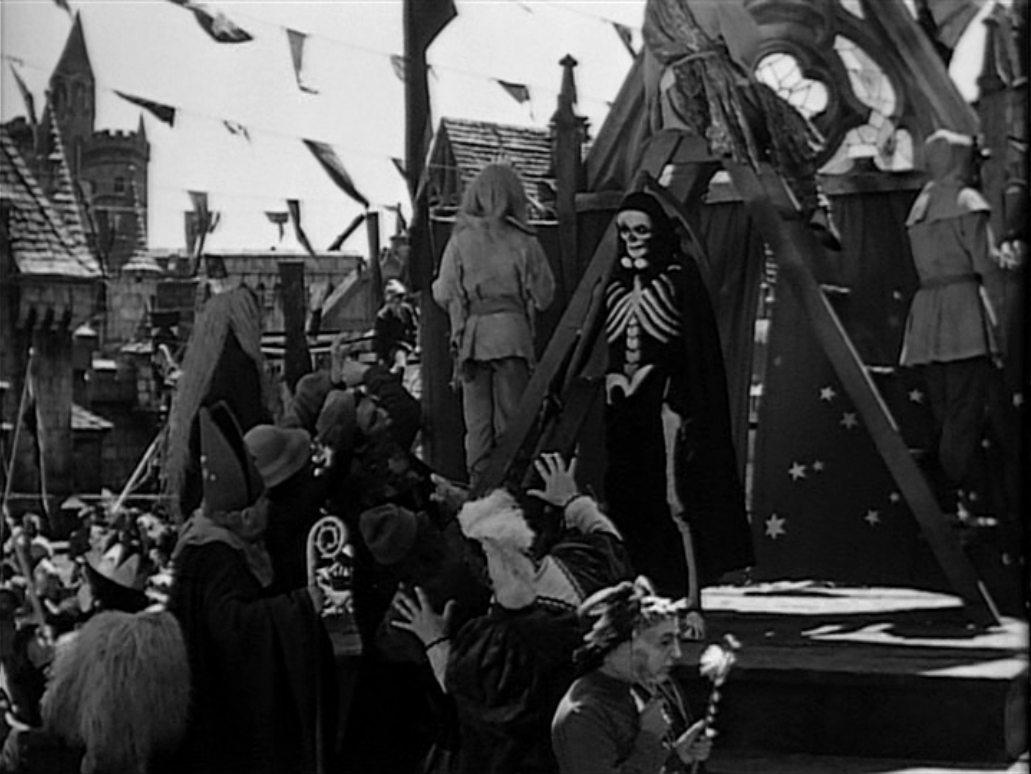
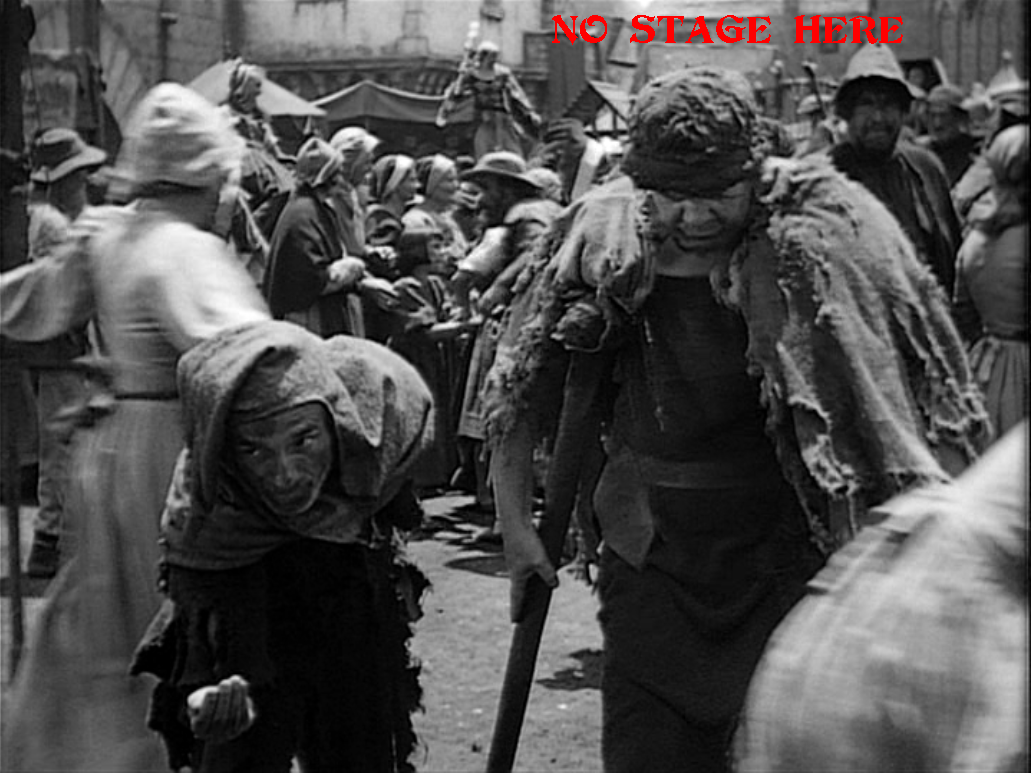
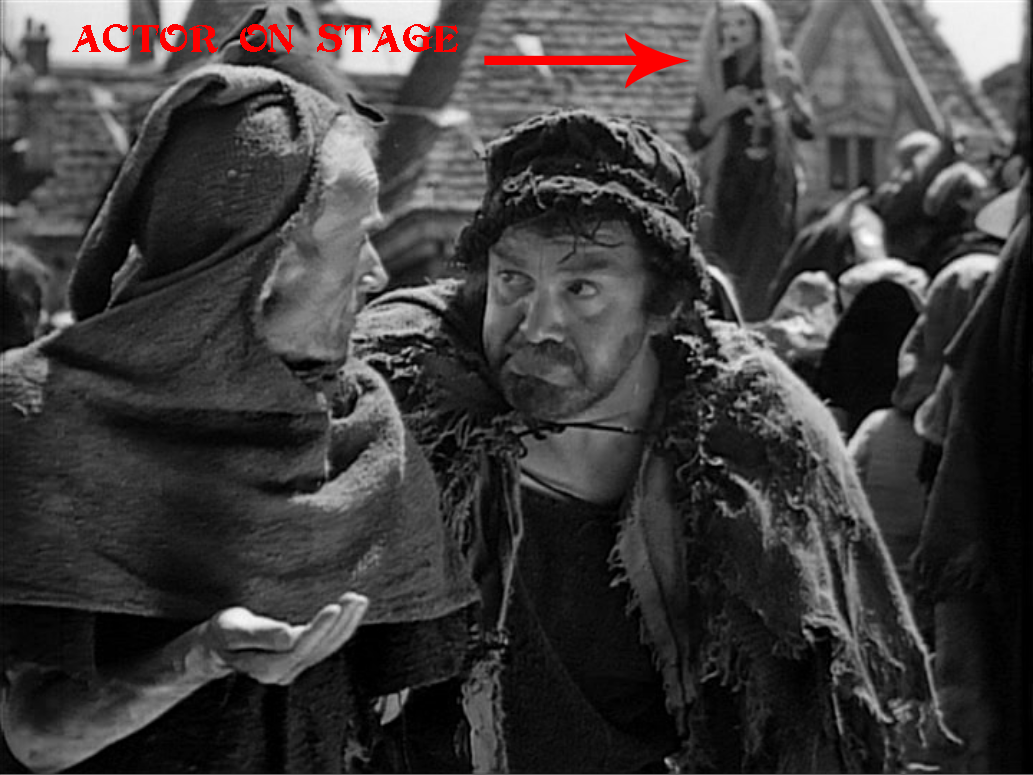
So it’s hard to gauge the characters’ movement in the film space. For the most part I say that the characters use the spaces logically but it’s hard to gauge where the characters are in relation to each other in the space in a given scene. A good example of this is during the Feast of Fools. First you see Louis and Frollo sitting in the royal box watching the festivities. From their vantage point they can see Gringoire’s play. The beggars start to complain that they’re not get money because of the play.
Beggar in long shot
Beggar and Clopin Medium shot
(Edit Alert; in the longer shot as Clopin walk up you can’t see the stage but when the scene cuts to a medium shot of Clopin and the beggar the stage can be seen).
Clopin puts an end to Gringoire’s play and then on the same stage the King of Fools contest begins. As the contest starts we Louis and Frollo talk about it how ugliness is fascinating and how the noble seem interested.
Extras watching the King of Fool contest
Phoebus (left) watches Esmeralda
The scene cuts to nobles looking at the stage, it is in this line up of nobles that Phoebus is seen making a comments about Esmeralda who is dancing.
Esmeralda spots an eyes staring
The crowd drags Quasimodo to the stage
As she dances it’s hard to make out where the stage is but it seems to be to left. Louis and Frollo in their box are watching her and looking slightly to the right, as well as Gringoire. Louis and Frollo have to be somewhat close to her as Louis throws her some money without much effort and Quasimodo is hiding under the royal box and Esmeralda can see him staring at her. The crowd then drags Quasimodo to stage which looks like a long distance from the box.
The distance could be attributive to Quasimodo trying to escape the crowd or it’s because the Director William Dieterle was a student of German Expressionism which likes twisting scales and playing distortions. It any case this scene it has some logic but you can’t get a feel for the space. Where is the royal box? How far is it from the stage? Where is Esmeralda performance in relation to the stage and the royal box? These are questions that the film never quite answers because it’s to hard to decern the space, the movement and spacial relation
It can be hard to judge acting from a film that is decades old from the vantage point of the modern era. The 1930’s had a very different style of acting and therefore different criteria for what was consider good and bad. So with that in mind I’m going to look at the acting from the 1939 version of “The Hunchback of Notre Dame”
I would say the acting is good across the board. No one hams it’s up nor under acts. The actors have grasp of how their characters are suppose to behave in the film. They even muddle through some of the more awkward dialogue far better than actor’s of today.
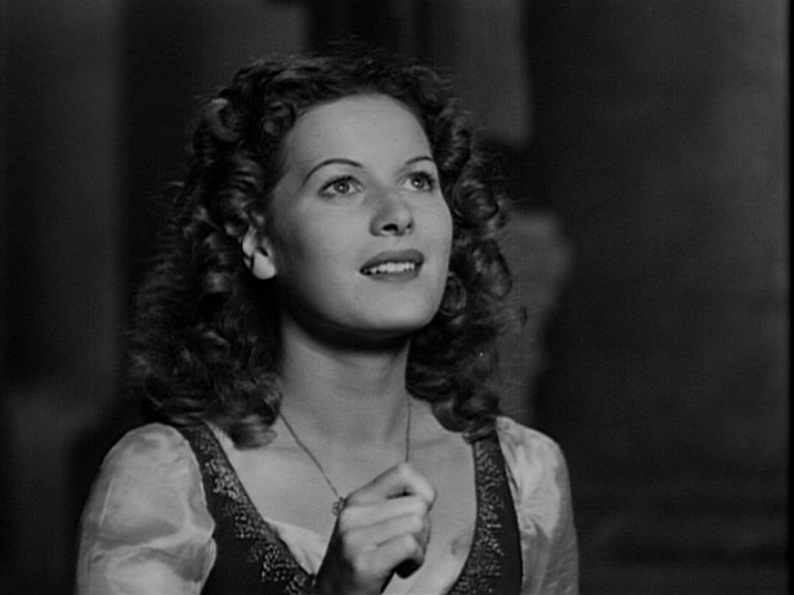
Esmeralda looking at the Virgin Mary (Maureen O’Hara) 1939 Hunchback of Notre Dame
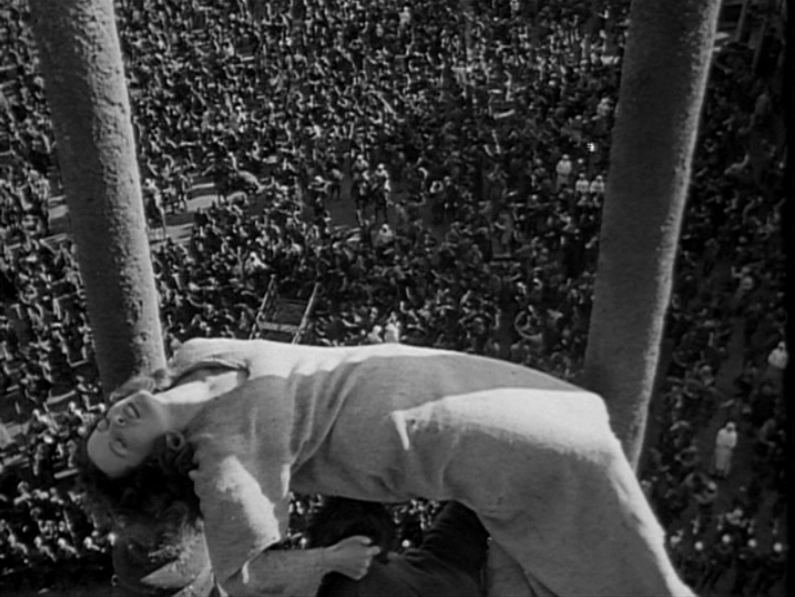
Esmeralda (Maureen O’Hara) – This was O’Hara’s American debut and was still fairly new to film but not to acting in general. Despite looking very Irish and not very Gypsyesque, she does well in the role. She plays up concern for her people but she demonstrate a coy side. I don’t think the role is particularly demanding on the acting front nor do I think it’s the best performance of her long career but it was a great debut for her for American audiences. I will give her credit, she did her own stunts (not just in this film but all her films). The stunts in this film were when Quasimodo swung down to rescue her from the gallows and where he lifted her over his head claiming “sanctuary”. The lift was the most dangerous of the two stunts. She and the stunt man where about 40 forty feet off the ground which was cobblestone and without a safety net.
Quasimodo declares SANCTUARY for Esmeralda (Charles Laughton and Maureen O’Hara) 1939 Hunchback of Notre Dame
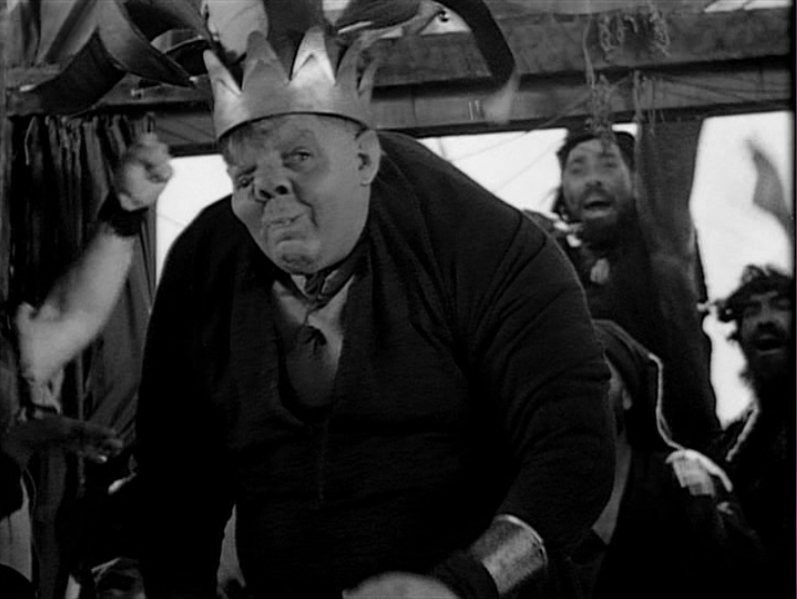
Quasimodo is crowned King of Fools (Charles Laughton) 1939 Hunchback of Notre Dame
Quasimodo(Charles Laughton) – Laughton excels in the role. Quasimodo is the most technically and psychically demanding role in the film. Laughton shines though all the make-up. He doesn’t make Quasimodo morose or monstrous instead he plays the role more pitiable and human. I do enjoy with mannerism especially during his brief reign as King of Fools and after his abdication and ringing the bells with his feet.
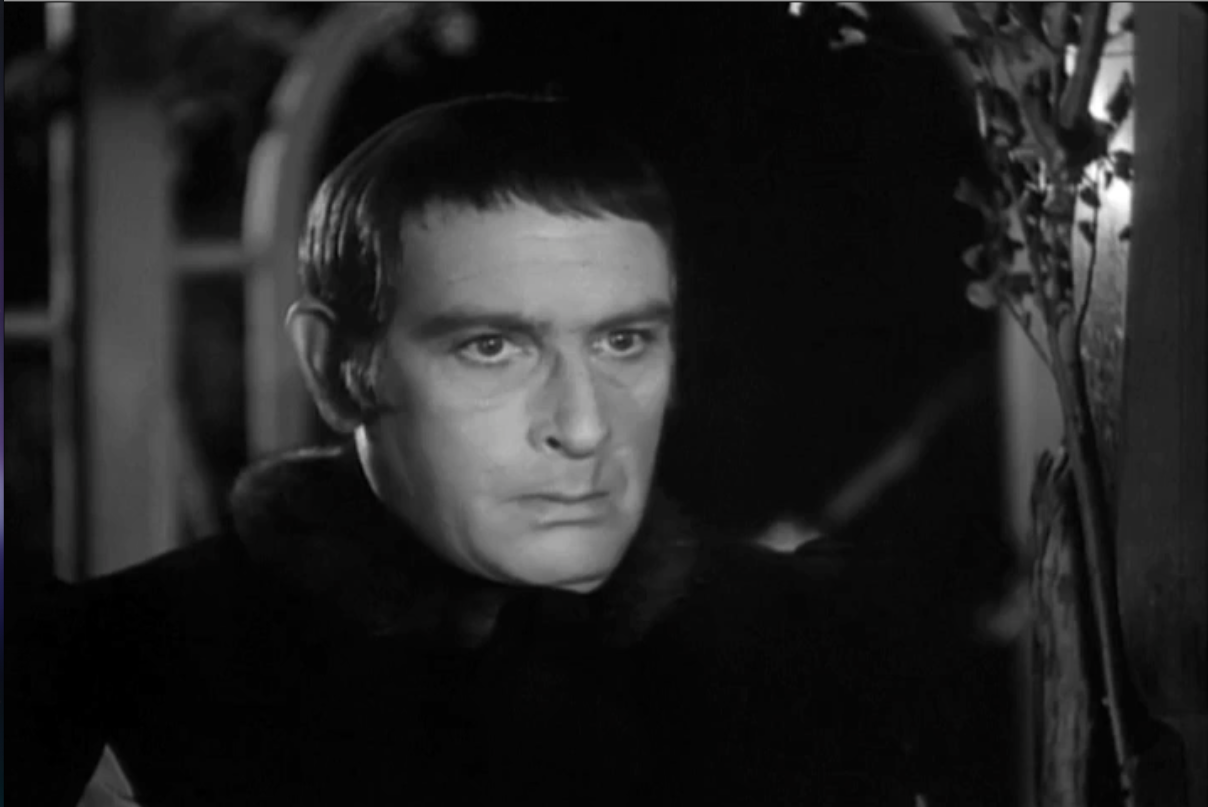
Jehan Frollo 1939 Hunchback of Notre Dame Sir Cedric Hardwicke
Jehan Frollo(Sir Cedric Hardwicke) – Hardwicke’s plays Frollo with a restraint manner and never teeters into the fevered obsession that the book Frollo exhibited in the book. However other Frollos have played him in this manner so it’s not a huge deal plus Hardwicke’s Frollo makes you forget that aspect of Frollo’s personality. Despite this restraint there are scenes where you can feel craziness behind the facade of control. Like any second he could lose that control and become raving mad and it would still feel in character.
Jehan Frollo, Sir Cedric Hardwicke, 1939 Hunchback of Notre Dame Sir Cedric Hardwicke
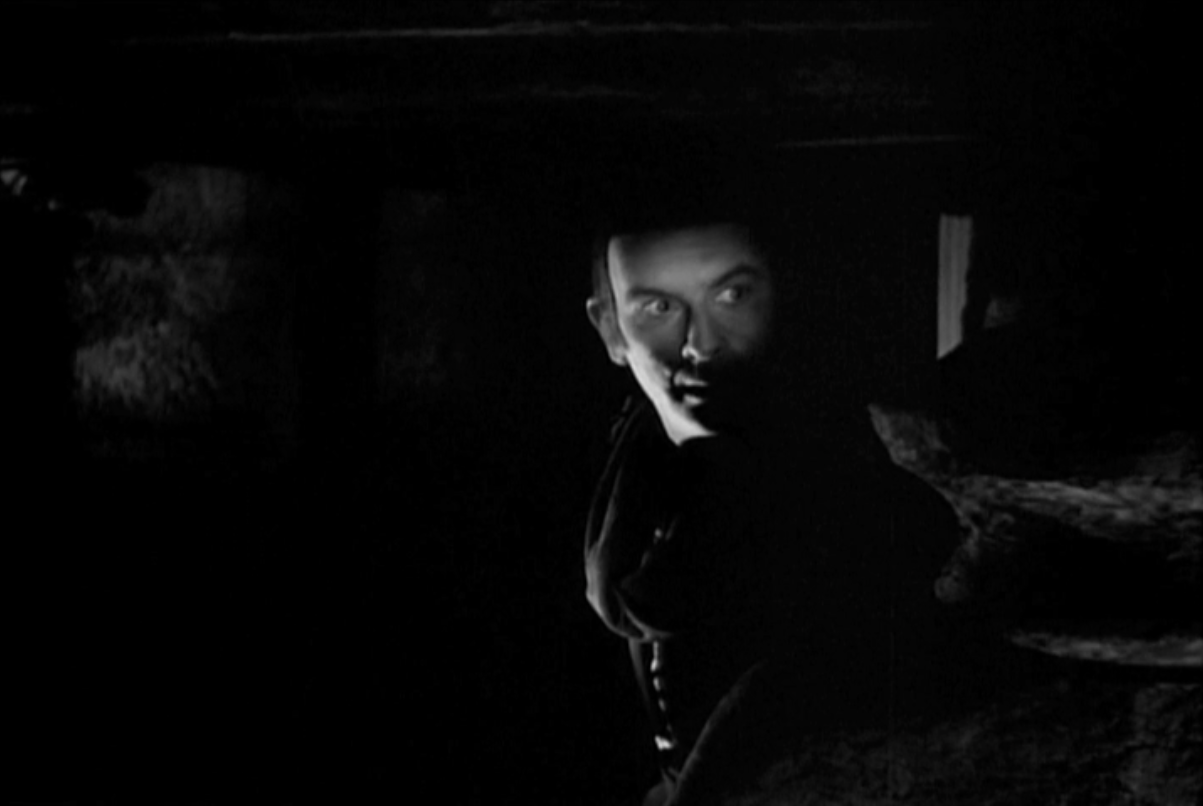
Gringoire and Clopin (Edmond O’Brien, Thomas Mitchell) 1939 Hunchback of Notre Dame
The other actors Edmond O’Brien, Harry Davenport, Thomas Mitchell, Alan Marshal and Walter Hampden are all good in their respective role and in the case of O’Brien made a great film debut.
The acting is good and there not too much I can really say other than what I’ve already said without getting into 30’s acting conventions.
Let me first say that I love costumes, I’m a sucker for period films with pretty costumes. With that being said, with one major exception, the costumes in the 1939 version of “The Hunchback of Notre Dame” are middle of the road. They help define the setting of the story and characters. But most of the costumes are not recognizable within film nostalgia (save for one).
Plunkett’s design for Esmeralda
The costumes were designed by Walter Plunkett. Walter Plunkett was the costume designer for “Gone with the Wind“. Perhaps designing grandiose Southern Belle/Victorian bustles is a tad more fun than designing costumes for medieval Parisian and nomads. To the film’s credit it did have a ton of extras to cloth and they all look their parts.
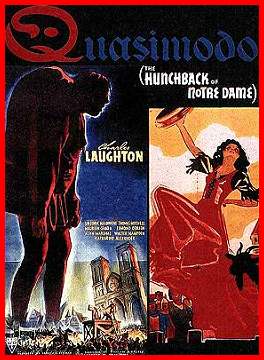
Movie poster for 1939 Hunchback of Notre Dame
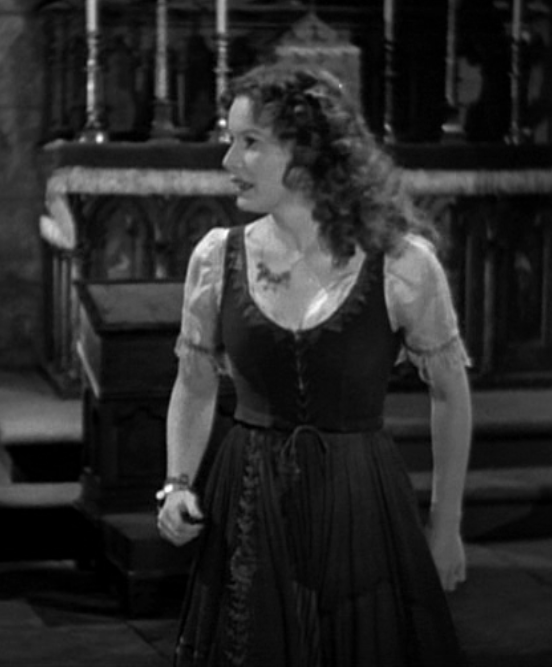
Esmeralda– Esmeralda gets about three costumes though one is a plain white linen chemise she wears before she’s almost hanged.
Her costumes are stylized and by no means accurate, like most costumes in movies, it’s time’s interpretation of whatever period the film is depicting. Esmeralda’s main dress is a long skirt with some patch work detail, a blouse (I suppose it’s moonlighting as a chemise) it looks like it has a slight sheen and also has fringe detail and a corset with some spangle detail.
As for accessories she has a necklace and bracelet and of course being a gypsy dancer a tambourine. Her second outfit is a blouse with an embroidery detail at the neck and on the sleeves. She sports a long skirt with more embroidery. She also has a belt with a rather large buckle and a head scarf. Both of these design are derived from Plunkett’s design. As for the color of these costumes my guess would be her main one is red (though one movie has it’s a as purple and another movie poster has it as red) and I would guess her performance outfit is a blue skirt and a white blouse (though who can tell through shades of grey but the two costume are different shades of grey. Her costumes do read “nomad” but they’re not overly gimmicky. Though it is hard to speculate what the group would have been wearing in the late 15th France. Paintings from the 16th century depicted Romani wearing a sari-like garment.
Close up of Quasimodo’s make-up
Quasimodo’s Hunch
The Crown for the King of Fools
Quasimodo – As I mention there was a major exception to the run-of-the-mill-i-ness of the costumes and while technically this applies to make-up it still counts.
The make-up for Laughton’s Quasimodo was masterful. A collaboration between Laughton and Make-up artist Perc Westmore and costed $10,000. Laughton & Westmore went through numerous versions and they were rejected by Laughton. He wanted his face loop-sided, so a mask had to pull the right side of face up and the left side down. A false eye was placed on his cheek and Laughton wore a colored contact in his right eye to make it look cloudy. The hump weighted 4 pounds and made of aluminum scaffold filled with a foam rubber and covered with a thin layer of elastic. Laughton wanted it to be heavy so that he could feel physical pain of walking. He also had an inch added to the sole of his left show so one leg would be shorter that other creating a natural limb. (this information is from Maureen O’Hara’s book “‘Tis Herself“). For Quasimodo the only requirement is the physical look and Notre Dame, Quasimodo can be in Tux and you would know who it is. One more thing on Quasimodo’s get-up, the King of Fool crown is a nice blend of a crown and jester’s hat.
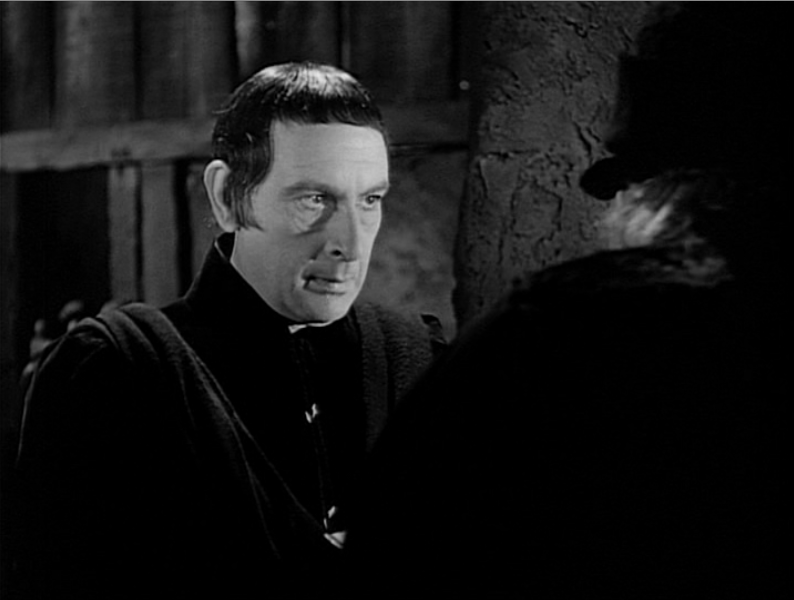
Frollo’s costume
Frollo – The villain, he wears all black and has a severe look, straight almost square cut to the hair (he’s a squareム). It looks to me that he wears velvet which is the blackest fabric and there is very little details to break up the costume so it looks like stab of black. He has a hat that has a built in cowl and has a fur trim a round his neck. All black, all severe, all rich fabric, his character is very clear he’s rich, powerful and EVIL (or just an antagonist).
King Louis’s Costume
Louis– I’m going to mention Louis because he’s a counterpoint for Frollo because Louis also wears all black but he has many details to break it so the black reads as a power color and not evil. He looks like a medieval kings, some regalia but more casual. He also sports a hat with jewelry, more jewelry, and a fur vest. Black but approachable yet kingly.
Gringoire as a Harlequin
Clopin’s Feather Hat
Phoebus in armor (on left)
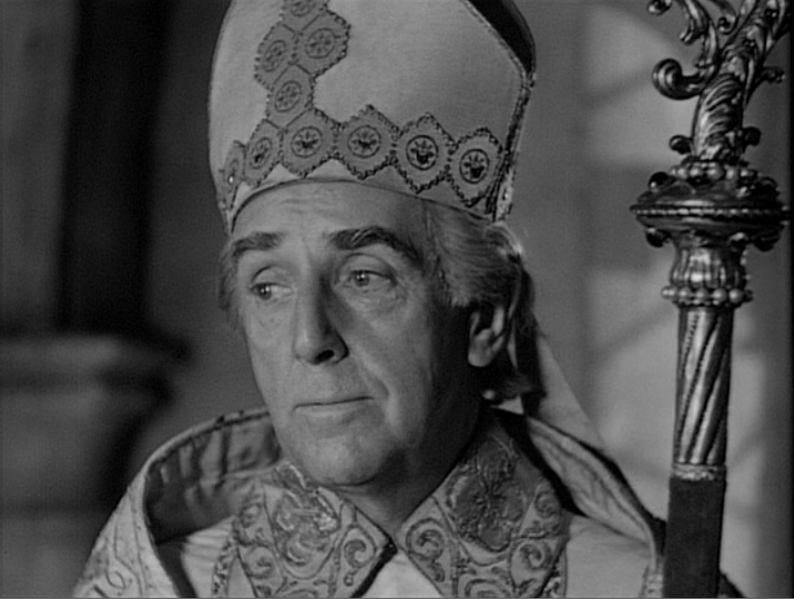
Archdeacon Claude in less than period vestments
The Rest – Gringoire and Clopin wear pretty standard tunics nothing too special except Clopin has a big old feather in his hat. Gringoire also get a harlequin outfit for his performance at the party and it’s pretty standard. Phoebus a suit of armor and it looks very silly. Phoebus also has some party garb it a cape and tunic basically none special not like his armor. Claude the Archdeacon’s costumes looks more current(even by modern standards) than what a priest of 1400’s would have wore.
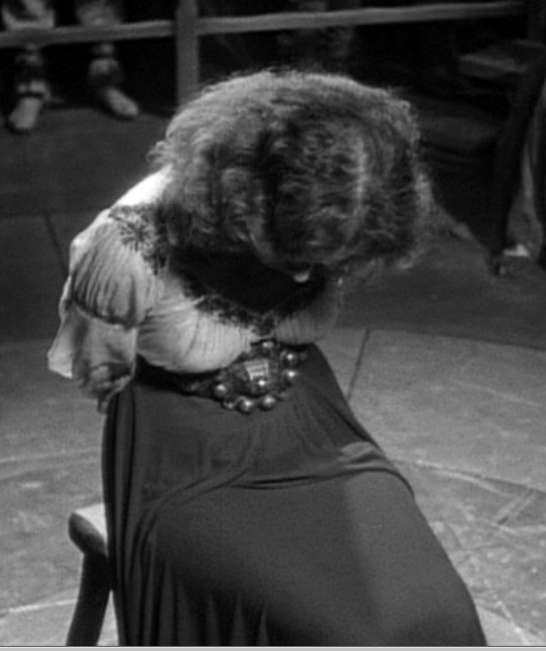
The Buckle on Esmeralda’s costume
Extras with 30’s hairstyles
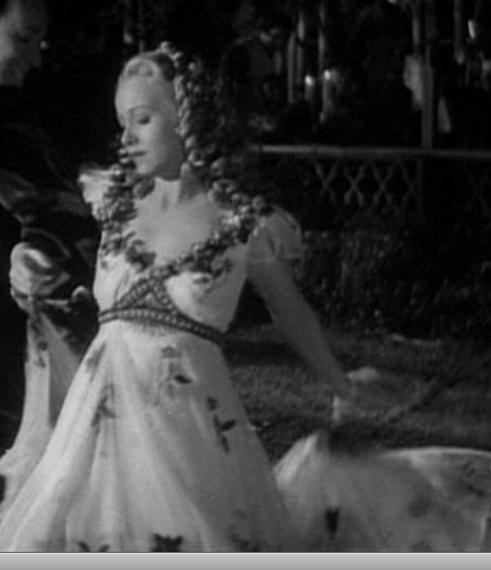
Fleur in Chiffon
Finally being a film from the late 30’s there are costumes and accessories peppered throughout the movie that look more 30’s than medieval. Claude’s vestment (seen above), Esmeralda’s belt buckle (belts were more for swords not fashion), the extra’s hairstyle (note the length and curls) and Fleur, a glorified extra that gets a name, her dress screams late 30 design so much so that it stands out in my mind despite the fact that you only see it for a moment. The dress is made from what I can guess is a chiffon. Chiffon is not even remotely a fabric that would have been used in the 1400s. Chiffion was invented in the 18th. (Fun fact – Chiffon is french for “rag”).
More on another aspect of Mise-en-secene next time – Acting




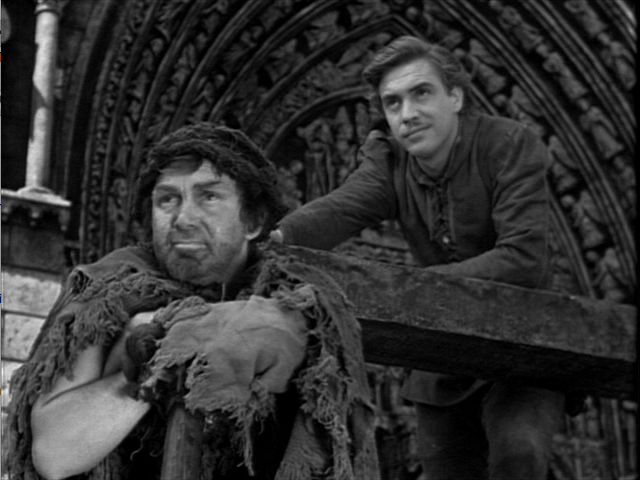
 are middle of the road. They help define the setting of the story and characters. But most of the costumes are not recognizable within film nostalgia (save for one).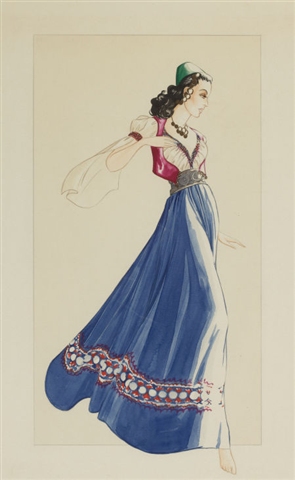
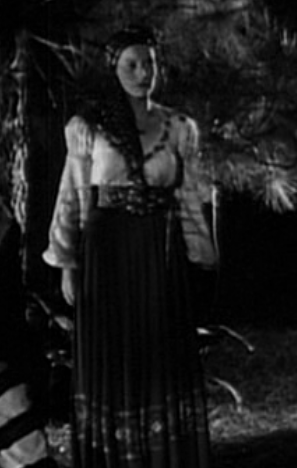
 ) and I would guess her performance outfit is a blue skirt and a white blouse (though who can tell through shades of grey but the two costume are different shades of grey. Her costumes do read “nomad” but they’re not overly gimmicky. Though it is hard to speculate what the group would have been wearing in the late 15th France. Paintings from the 16th century depicted Romani wearing a sari-like garment.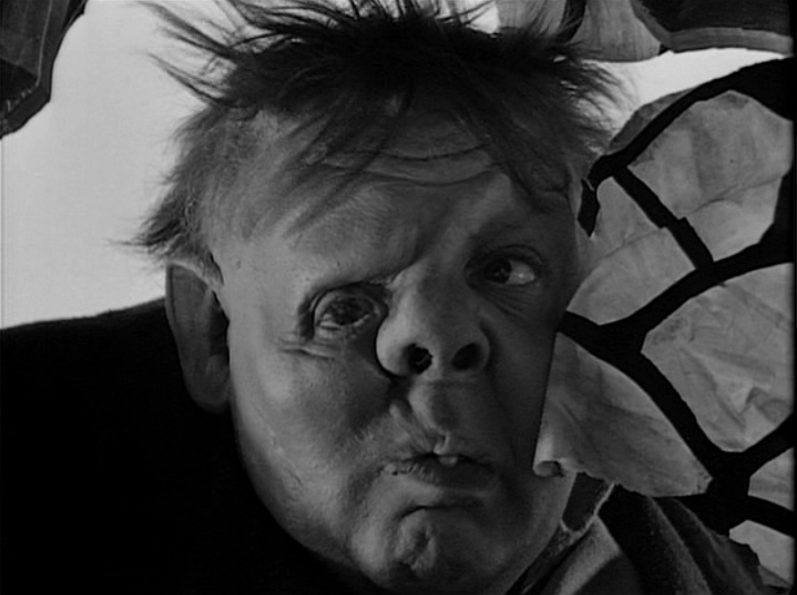

 “). For Quasimodo the only requirement is the physical look and Notre Dame, Quasimodo can be in Tux and you would know who it is. One more thing on Quasimodo’s get-up, the King of Fool crown is a nice blend of a crown and jester’s hat.