
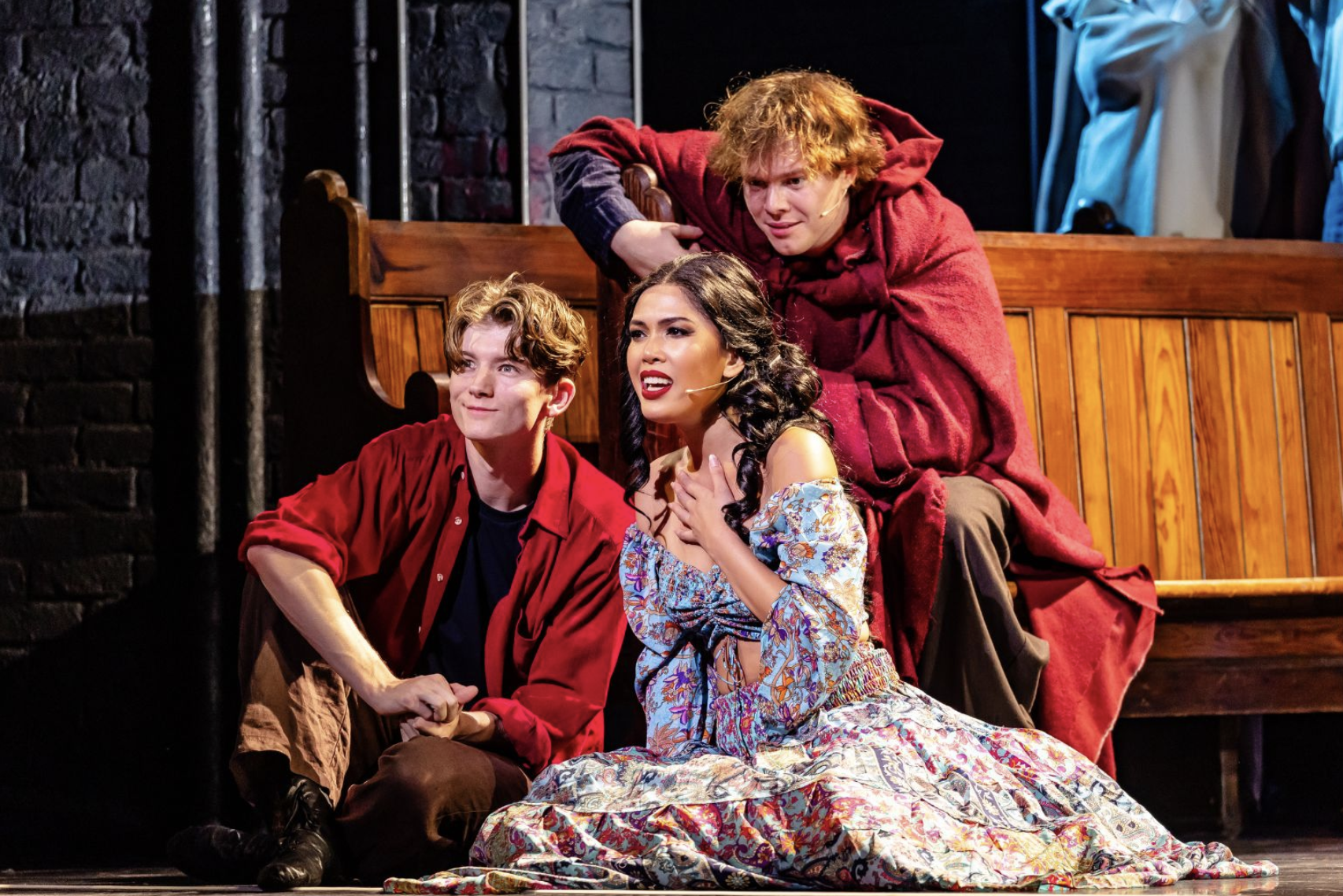
The musical stage version of The Hunchback of Notre Dame is a very interesting experiment in adaptation. It’s based on a German musical based on an animated movie which itself was loosely based a French novel. The stage musical itself also tired to combine all these sources into one production resulting in a mixed bag, though many people love it.
Another aspect of the this musical is because it went to regionals there are a lot of iterations, some are amateurs productions and some are more professional.
One professionally produced production that is currently getting a lot of attention is the West End concert version of The Hunchback of Notre Dame at The Prince Edward Theatre in London. The production staged by Jack Maple.
The reason for this controversy is over the casting of Quasimodo. The role is being portrayed by two performers, Ben Joyce and Oliver Hewing. Joyce sings the role and Hewing interprets the role through BSL and dance. Hewing is meant represent Quasimodo’s inner life This casting is similar to the 5th Avenue Theatre Production as Quasimodo was played by Joshua Castillo, a deaf actor and the singing of the was performed by E.J. Cardona who was dressed like a gargoyle.
So what is the controversy surrounding the casting of Quasimodo for the West End concert? The critique is coming from Equity, the performing arts trade union. Essentially the critique is more about the casting focusing on one of Quasimodo’s physical impairments and not the others. “Equity states that while ‘the production explores the character’s deaf identity’, it claims that the character’s hunchback is ‘intrinsic to the story’.”
As the English title evokes, Quasimodo has a hunchback or Kyphosis. He also has a protrusion over his eye which impairs his vision in one eye and partial deafness. In book nine, chapter three of the novel, Quasimodo gives Esmeralda a whistle which he tells her he can hear. Also in Book four, chapter three it’s mentioned that he can hear the bells. His deafness was caused by the bells rupturing his ear drums at the age of fourteen. In the musical Quasimodo’s deafness is caused by the bells but without rewatching the musical it’s unclear if he partially deaf or completely. It might differ from production to production.
The concept behind Equity’s argument for casting the role of Quasimodo is well-intentioned. It’s about representation and casting the role authentically to character’s lived experience of existing with all these facets of disability and impairments. Equity’s statement has more to do with casting a deaf performer over a disable performer. The statement goes on to say the casting and example of ableism. While Quasimodo’s characterization is shaped by his hunchback, he also profoundly shaped by his deafness as losing his hearing essentially completely shut him off from the rest of the world. “The only avenue which Nature had left him open to world was suddenly closed forever.” (Book 4 chapter 3)
The argument Equity is making is for a professional productions to cast a physically-disabled artist though no where in the statement is “Kyphosis” specially mentioned. Natalie Amber, The Chair of Equity’s Deaf and Disabled Member Committee goes on to say “To highlight one facet while overlooking another erases the lived experience of people with physical impairments and is an example of ableism. While we welcome the inclusion of BSL interpreters, neurodivergent, and Romani performers, it is important to recognise that diversity is not a trade-off. Representation of one marginalised group does not excuse the erasure of another.” (source)
The idea is one that aligned to the values of representation but it does seem like a myriad of considerations arise from the idea of finding the ideal right artist who ticks all the boxes. A stage performer who is in the right age-range who has Kyphosis, visual-impairment, and deaf. Not to mention that this musical adds yet of another facet to Quasimodo that is overt and well-stated in the musical, he is half-roma.
All of this is to say it’s not as easy as find the right person, there are structural issues which do not empower disabled performers to get roles or even train disable people to be performers. And then the constant discourse over acting itself versus representation and authenticity to characters.
It’s a very nuance conversation and one that is not black and white but very gray. There is no clear answer. Just because there might be that one ideal performer for the role of Quasimodo, they might not even have the pathos or emotional resonant for the role or who to say they would even want the role? The Daily Mail article on this controversy highlighted some feedback Equity got on social media that were mixed.
As it stand this concert production of “The Hunchback of Notre Dame,” which runs till August 24th, is getting positive reviews. So while the reception of the production doesn’t negate the issue Equity brings up, it still a good thing that this production showcases one facet of Quasimodo’s lived experience.
While I think it’s important to give people that have impairment the chances to work in the artistic media, I think we are also forgetting the essence of an actor’s work that is to represent or act like something he isn’t. It would be akin to saying I need to hire an actual doctor to a hospital drama. I haven’t seen the musical, but people need to take on consideration the actual mobility of the performers and what they’ll be required to play. If that is a problem perhaps they should push for a new production of Hond that’s mobility friendly to people who might have mobility issues.
Imagine if they took someone with a facial deformity to play poto. It would be vilanizing the person and linking it to their actual identity – now the phantom is a villain or an anti hero, Quasimodo is a hero without villainess, so it might be different, but needs to be considered too.
I loved Esmeralda dress in this photo, so colorful. Do you have one of her standing where the dress can be seen clearly? I like that it’s not red neither green.
I do not have a good picture of the costume but Christine Allado has posted many pictures of herself as Esmeralda across her social platforms, which do show off the costume better.