Just to keep this blog fun I’m going to post some hunchback related fun so enjoy this offering ^_^
http://youtu.be/gXq4gVrz28s

Next Character – Clopin – The Story Teller plus that Large life character who gets the big Musical Numbers
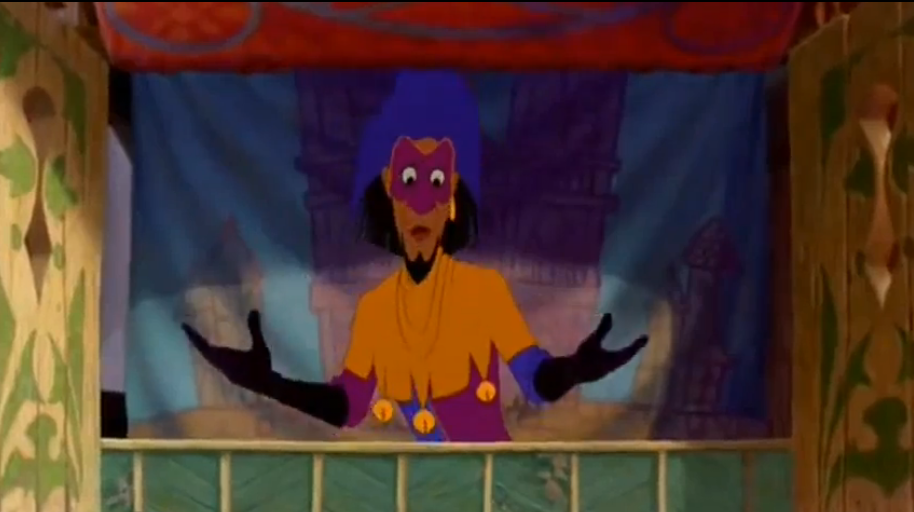
Clopin Disney Hunchback of Notre Dame
Clopin (voiced by Paul Kandel) is the Leader of The Court of Miracles, Master of Ceremonies and Story Teller of the film. He accomplishes all this with only about 8 minutes of screen/voice time in the movie. Amazing! Clopin also gets three song which means he sings the most songs in the film and each song is big and over the top. Despite his limited screen time Clopin exhibits a lot of personality. He’s fun loving, mischievous diplomatic, funny, and somewhat nice. He also has a puppet version of himself (he also has one of Frollo. Makes you think who else does Clopin have puppets of?)

Clopin Puppet Disney Hunchback of Notre Dame
Isn’t it Cute???
Examples of Clopin varoius roles: Master of Ceremonies The Court of Miracles, and Story Teller.
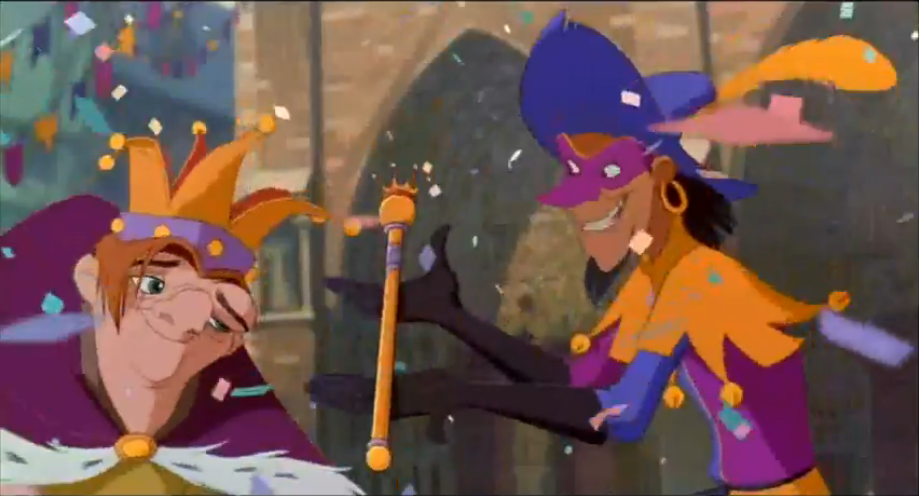
Clopin presenting Quasimodo as the "King of Fools" Disney Hunchback Notre Dame

Clopin Disney Hunchback of Notre Dame
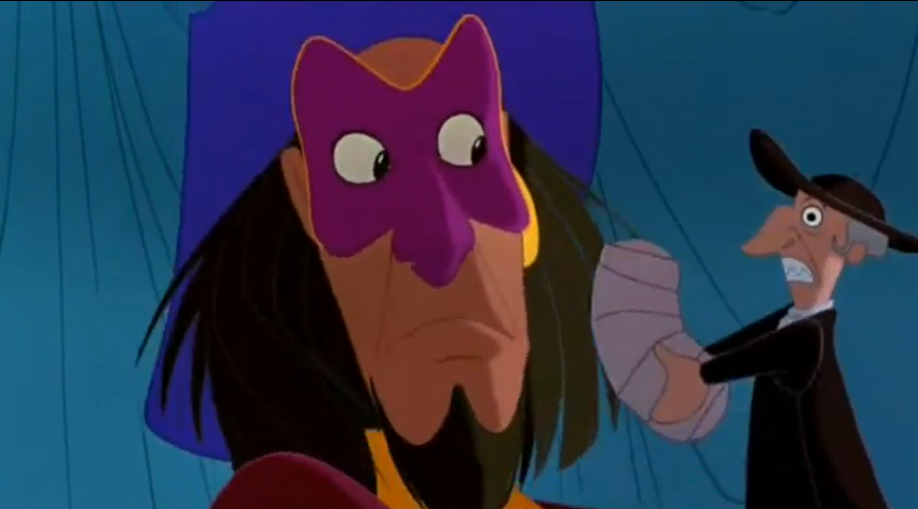
Clopin with Frollo Puppet Disney Hunchback of Notre Dame
Clopin has looks very similar to Kuzco from the Emperor’s New Groove. Has a long pointy long face, straight long black hair, pointy nose, and thin. Clopin is older and has a few age lines, balding (a little bit) a beard, bushy eye brows and some missing teeth. Clopin gets two costumes, a performance look and a casual look. Unlike Esmeralda he is seen more in this performance outfit. It Harlequin that is purple and yellow with bells on his neck piece, a purple mask, and long back gloves. He has wears a purple hat with a big yellow feather. The hat is akin to the one that Thomas Mitchell wore in the 1939 version. Clopin casual costume looks similar to this performance garb but it all purple and less festive. He also wears the same hat. Like Esmeralda and Djali, Clopin also wears a single golden hoop earring. He cosplays (costume play) as Frollo. He also makes awesome expressions.

Clopin noticing Quasimodo during the Feast of Fools Disney Hunchback of Notre Dame

Kuzco from The Emperor's new Groove Disney

Clopin Disney Hunchback of Notre Dame

Clopin cosplaying as Frollo while tormenting Phoebus and Quasimodo Disney Hunchback of Notre Dame

Clopin cosplaying as Frollo overruling his puppet Disney Hunchback of Notre Dame

Clopin with Esmeralda Disney Hunchback Notre Dame
Clopin and Esmeralda have some connection to each other independent of being Gypsies and living in the Court of Miracles. Since Esmeralda performs with him in the Feast of Fool and she has some sway in the Court she must have some significant connection to Clopin. Since we’re given no back story for these two it’s impossible to know for certain. He either raised her, they’re related, or Esmeralda is just well liked in the Court of Miracles. I wish there was an answer but I guess this would have taken too much focus off of Quasimodo.
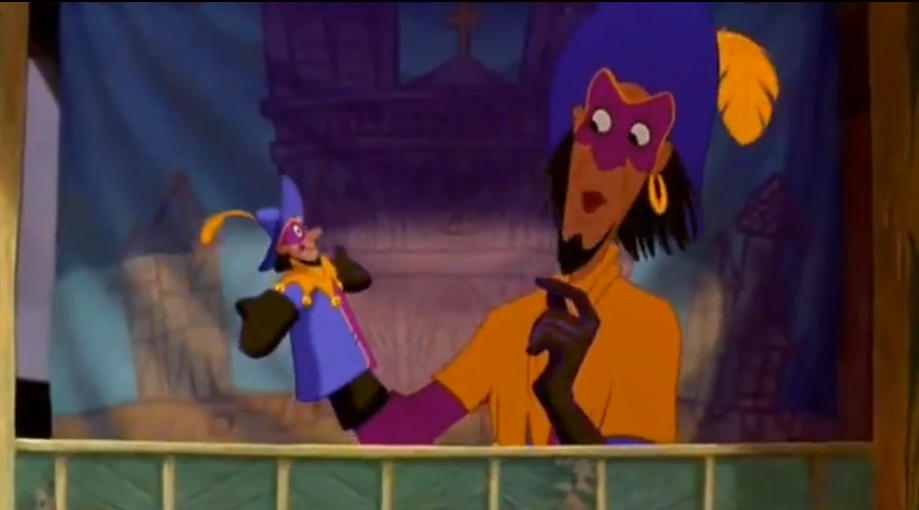
Clopin with Puppet Disney Hunchback of Notre Dame

Clopin Disney Hunchback of Notre Dame

Clopin at the end Disney Hunchback of Notre Dame
Like Phoebus, Clopin moonlights for the role of Gringoire. Gringoire in the book is a poet so in various versions Gringoire is a story teller, or the voice for the audience. Clopin fills this role, he tells the back story of Quasimodo and Frollo and reprises the theme of the film at the end.
Given his limited screen time there is not a ton that can be said for him as a character but he one of the most enjoyable characters in the film. He should have gotten more screen time!
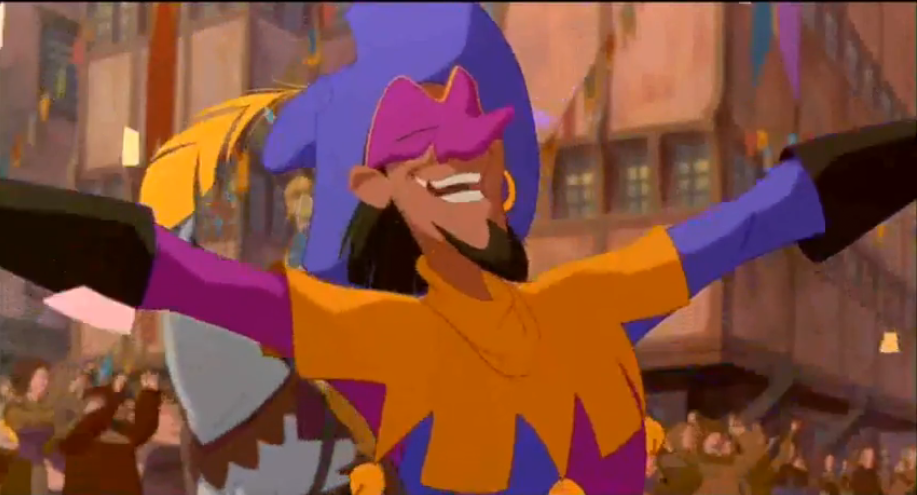
Clopin Disney Hunchback Notre Dame
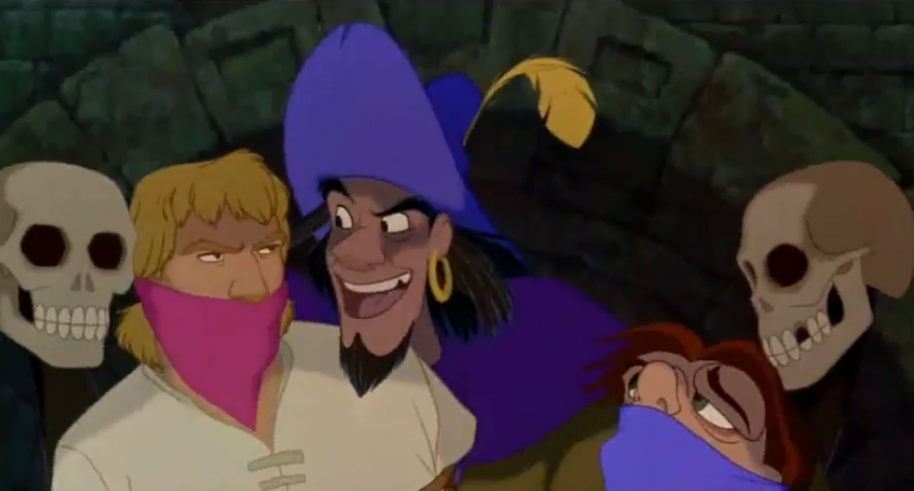
Clopin, Phoebus,and Quasimodo Disney Hunchback of Notre Dame
Clopin noticing Quasimodo during the Feast of Fools Disney Hunchback of Notre Dame
Next up
The Gargoyles (shutters)
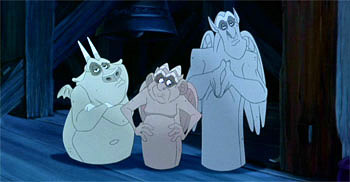
The Gargoyles; Hugo Laverne, Victor Hunchback of Notre Dame Disney
Hey People in internet land, make your opinions known (to me)! Who is your favorite character from Disney’s Hunchback of Notre Dame? I’ll go first, I like Djali and Clopin. Now it’s your turn, don’ t be shy, I’d love to know. And you don’t like anyone well then say so ^_^.
So what you may not know about me is that in addition to expressing a geeky fandom on a blog, I also make/edit music videos. Typically I use anime sources (another geeky fandom ^_^). So while I was reviewing the 1939 version I made a little promotional music video using the 39 version. Some of you may have seen it already but for those of you who didn’t,
or click here to view on youtube
Next Character – Phoebus – Auxiliary Hero?

Phoebus Disney Hunchback of Notre Dame
Part of Disney’s formula to success for their films of the 90’s are archetypes. You have the hero/heroine, villain, sidekicks both good and evil, some kind of parental figure and some kind of larger than life characters that’s usually one of the side kicks (they’ll usually get the show stopper of the film). Of course these are not set in stone, different characters are given different presidencies. So how does Phoebus fit into the Disney’s archetypes? That’s a good question, he’s not the hero that’s Quasimodo. He’s not the villain, Frollo fits very snugly into that role. He’s not the heroine – wrong sex. He’s not an annoying sidekick- the film already exhausted that one. He could be a villain sidekick as he worked for the villain but those are usually goofy or bumbling if a villain gets one at all and plus he not villainous. He’s kind of parental in the way he encourages Quasimodo but he’s not that archetype either. Mmmmmm, I’m out of archetypes. Well I guess Phoebus is the Auxiliary Hero. He does heroic stuff but all the credit goes to Quaismodo but Phoebus gets the girl. I guess Phoebus gets a better deal “half the work and a girlfriend.” Better luck in the sequel Quasi.
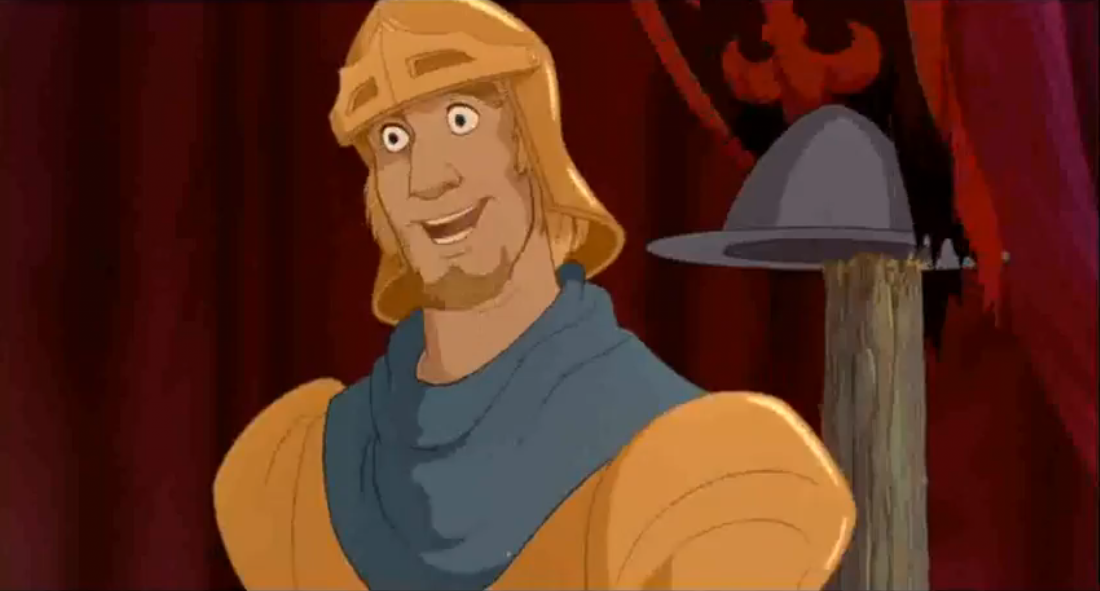
Phoebus Disney Hunchback of Notre Dame
Phoebus is a weird character in the realm of the Hunchback adaptions: sometimes he’s the hero, sometimes he’s an asshole, sometimes he just a plot point, sometimes you hardly notice him and sometimes he’s not even there. In this way Phoebus is like Pierre Gringoire. The differences between the two is Gringoire is a coward not a jerk and sometimes he’ll be the story teller. Now for the people who have only seen the Disney film, Gringoire is not in the film but his characterization was split between Clopin and Phoebus.

Phoebus and Achilles

Phoebus and Frollo Disney Hunchback of Notre Dame
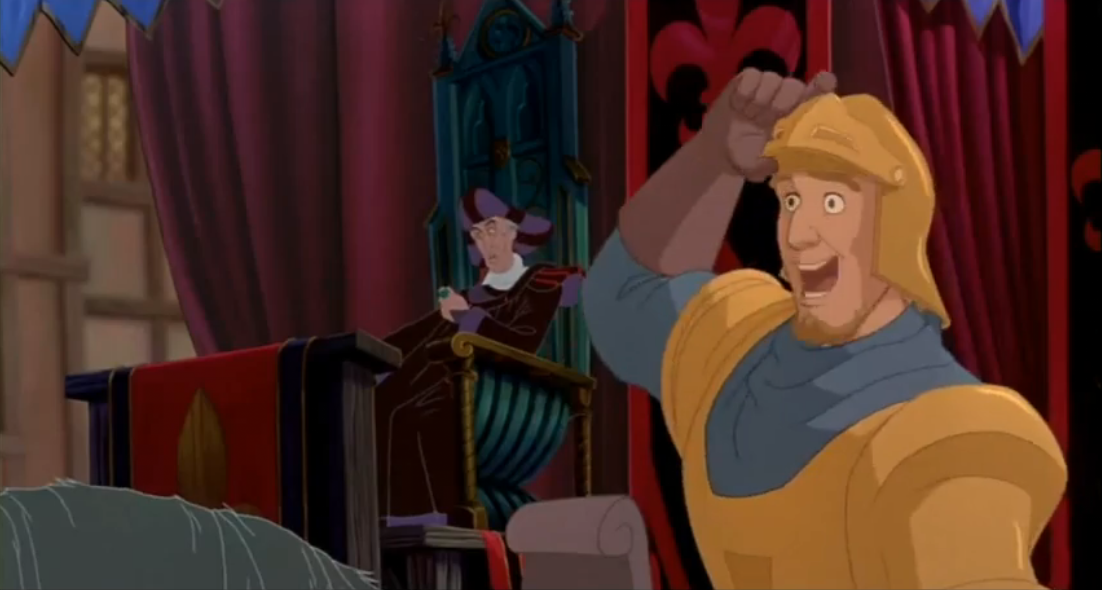
Phoebus noticing Esmeralda's "Disgusting Display"
We’ll get back to thought in a bit but let’s look a Phoebus a little. Phoebus (voiced by Kevin Klein) is a nobel who is a captain in the army. At the start of the film he gets a promotion to Captain of the Judges’ Guards which means he has to “take care” of Gypsies. This evidently wasn’t in the job description because he had no idea what he signed up for and he’s annoyed to come back from the wars to deal with beggars, street performers and fortune tellers. Phoebus has a dry wit, a lot of integrity and morality (He’s the male Esmeralda). He has a very different look than most disney men – he’s older and has facial hair (a first for Disney). He falls for Esmeralda very early in the film when he first sees her dancing and is further interested when he sees her “conflict aversion” skills (the chase scene).

Phoebus about to be executed Disney Hunchback of Notre Dame
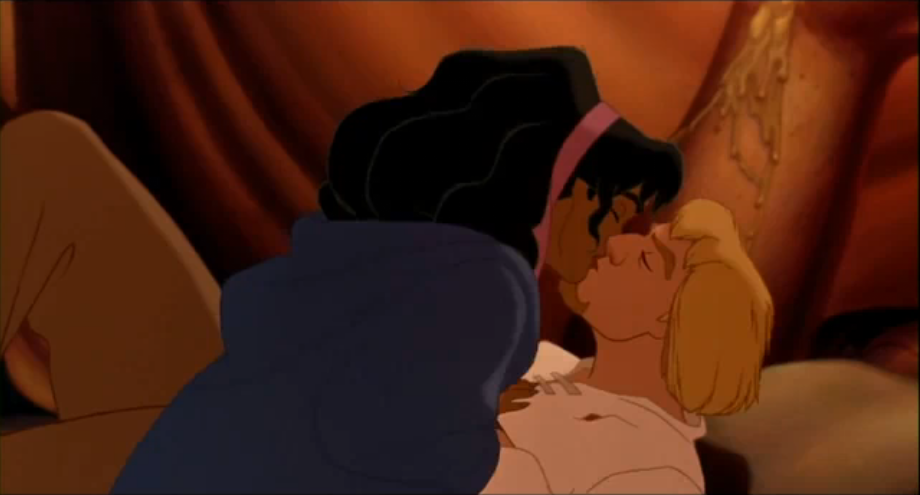
Phoebus and Esmeralda Kiss Disney Hunchback of Notre Dame
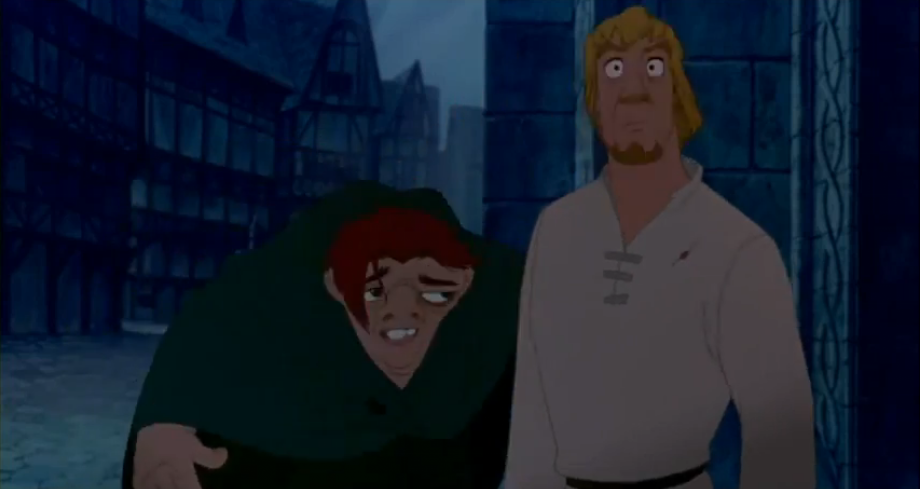
Phoebus and Quasimodo warn Esmeralda Disney Hunchback of Notre Dame
He saves Esmerlda from Frollo by saying that she claimed sanctuary which she never did. Phoebus proves to be of the hero variety when he stands in opposition of Frollo’s mad man antics. Phoebus is ordered to burn down a house of a family who accused of harboring Gypsies with the family inside. Phoebus doesn’t compile and saves the family. Because Frollo doesn’t take kindly to people not obeying his every little insane whim, Phoebus is to be executed. Esmeralda creates a distraction and Phoebus tries escape on Frollo’s horse but is shot and falls into a river and Esmeralda has to save him agian. Esmeralda takes him to Notre Dame for safety. It’s there where they share the longest Disney kiss (over 30 seconds). After Frollo announces he going to attack the Court of Miracles, Phoebus unwittingly encourages Quasimodo to warn Esmeralda and the rest of the Gypsies. So they find the Court of Miracle and after a brif encourter with the noose, he and Quasimdo warn the Gypsies to leave but Frollo shows up and arrests everyone. So Phoebus is to be executed after Esmeralda but luckily Quasimodo saves Esmeralda and Phoebus escape his cage and rallies the people to fights against Frollo. Phoebus then saves Quasimodo from falling off Notre Dame and happy ending are shared by all (except Frollo).

Captured Phoebus and Clopin Disney Hunchback of Notre Dame
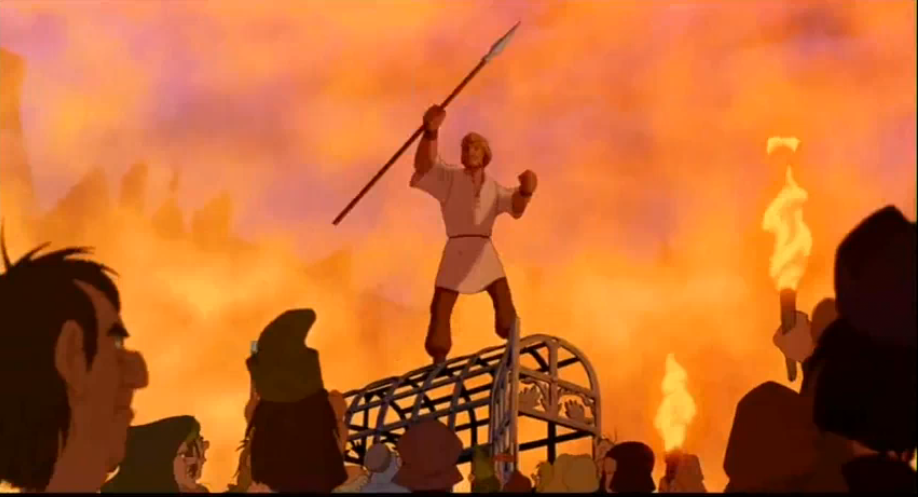
Phoebus Rallies the People Disney Hunchback of Notre Dame
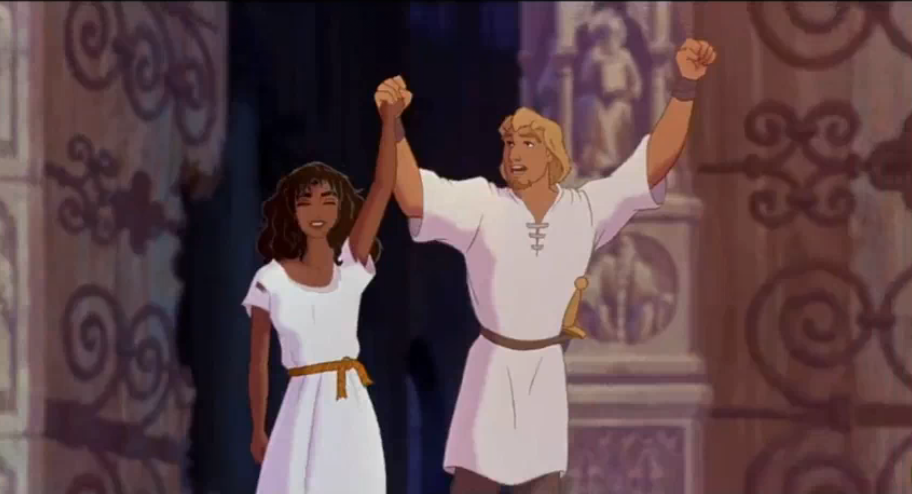
Phoebus and Esmeralda Happy Ending Disney Hunchback of Notre Dame
So Phoebus is a hero but Quaismodo is the focused hero and the film never wants you to forget that. Back to the thought of Phoebus filling in as Gringoire. Gringoire in the book has the best relationship with Esmeralda and that’s why so many of the films place these two together more than the Phoebus/Esmeralda relationship. The rallying of the people and helping Esmeralda are things that Gringoire exhibits. One of the deleted songs from the Disney version called “As Long as there a Moon” and it occurs right after Esmeralda saves Phoebus and Quasimodo from Clopin’s fun. It was supposed to be a love song for Phoebus and Esmeralda and it included a wedding ceremony where they smashed a pitcher. So Phoebus takes on Gringoire in this delated scene. The reason why it was delated is because the directors felt it took the focus off of Quasimodo but it really did throw off the pacing of the film
Phoebus – Hey Frollo’s coming leave now,
Clopin – Ok, but let’s have a wedding first,
Phoebus – Well that’s sensible

Phoebus Disney Hunchback of Notre Dame
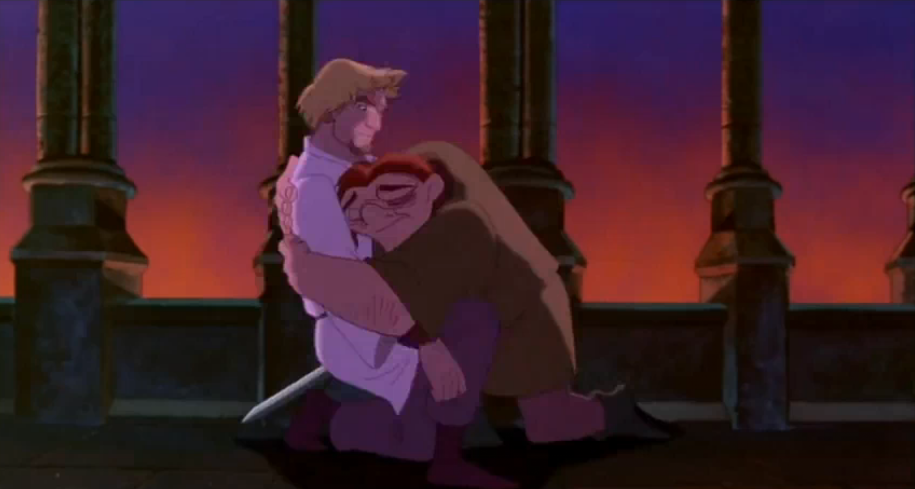
Phoebus and Quasimodo Hug Disney Hunchback of Notre Dame

Esmeralda and Phoebus Disney Hunchback of Notre Dame
Phoebus is a very mallable character that can be used to carter to the whims of the movie. In the Disney film he’s a male Esmeralda (think about it, they’re the same) he does everything Esmeralda does, stand for the same things, gets into the same scrapes as she does and is an agent of Quasimodo’s liberation. In book Phoebus is not that static of character, Phoebus changes in his regard for his fiancee Fleur de Lys. In the Disney movie he has a change, which was defying Frollo’s authority but from the word go he was never keen on Frollo’s politics so it was only matter of time (a day) for that insubordination to occur. Phoebus a fun character and he did prove necessary for the story that Disney was telling.
Next Character – Clopin
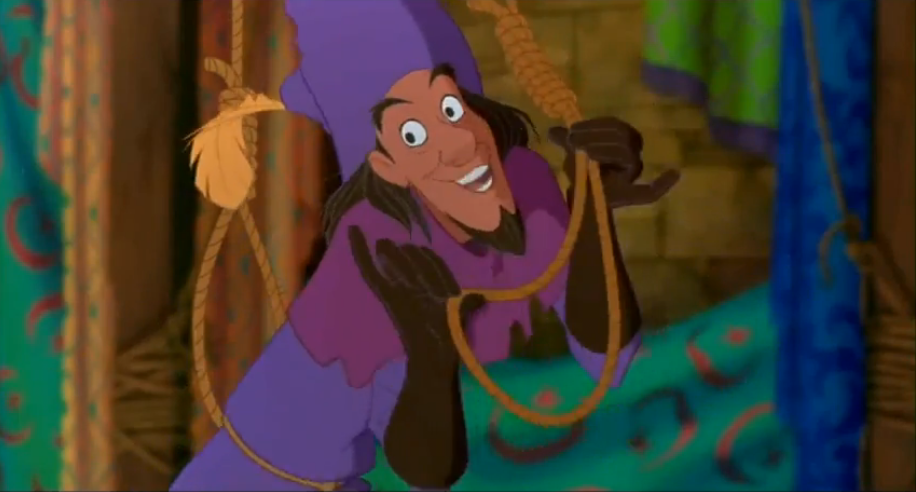
Clopin Disney Hunchback of Notre Dame
Tell me who your favorite character from Disney Hunchback? Just Leave a comment or just leave a comment about any old thing that you want to say about Phoebus or the Hunchback in general. Until Next Time!
Next Character: Esmeralda; The Heroine
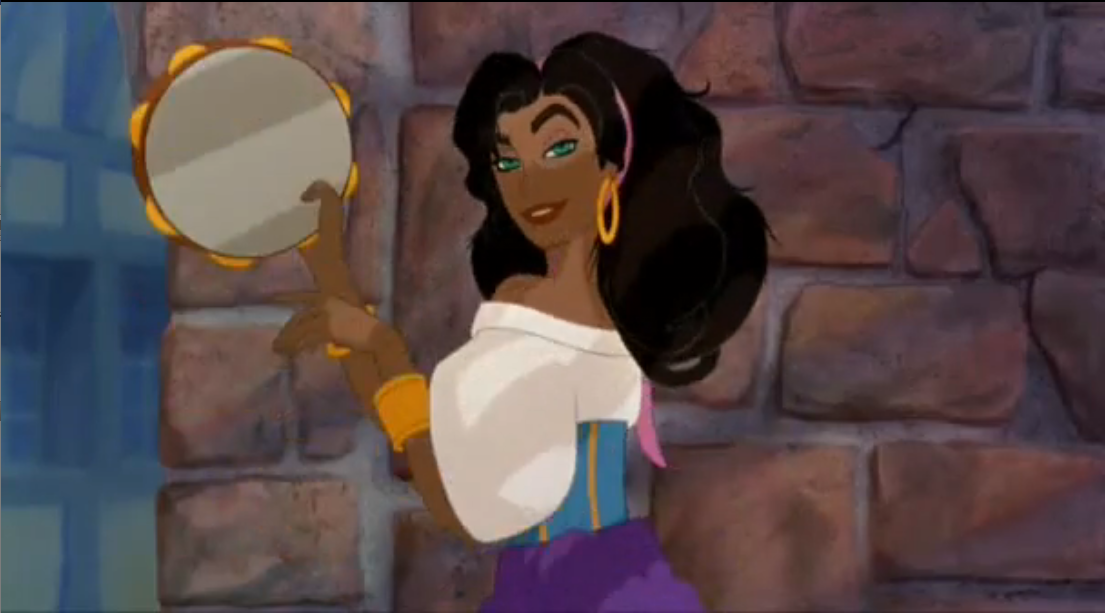
Disney Esmeralda Hunchback of Notre Dame dancing
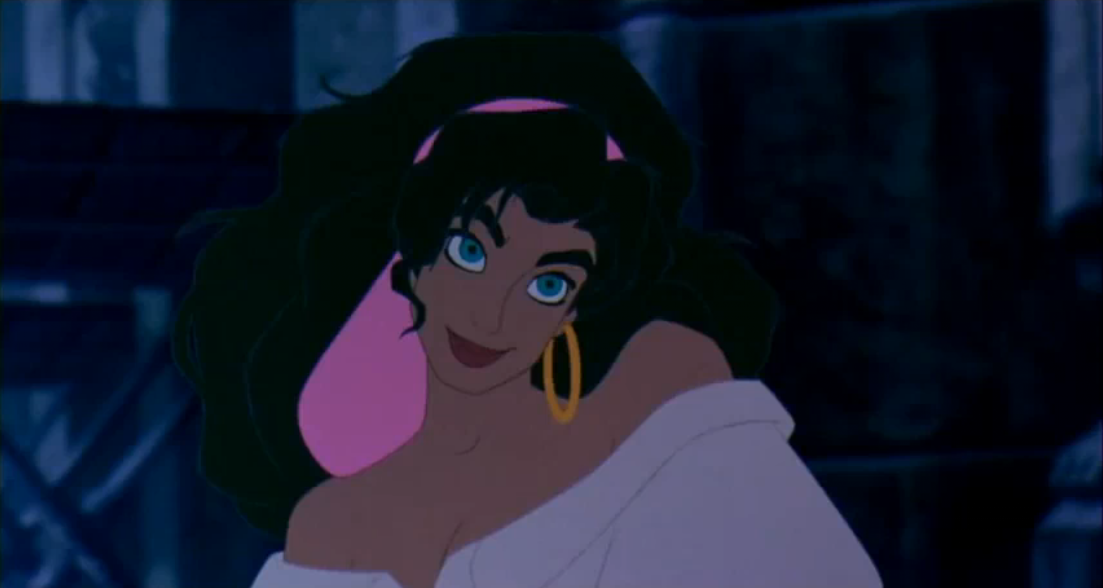
Esmeralda Disney Hunchback of Notre Dame
Esmeralda is a gypsy dancer who is the subject of the three male main characters’ affections. She’s very beautiful and sensual. In this version Esmeralda is 100% Romani. She has a dark complexion (darker than Jasmine), thick black hair and emerald green eyes (attributive to her name). She wears a white chemise blouse that off shoulder, a blue corset with thin gold stripes, a purple skirt with a darker purple kercheif

Esmeralda Disney Hunchback of Notre Dame Dancing
worn at the hip with coin trim. She wears some gold jewelry; bracelets, an anklet and one gold hoop. She were a pink scarf in her hair to keep her hair back. She has a second outfit, that is used as an formal dance costume. It’s red with purple flutter sleeves and a purple sash at the waist. In addition to her normal jewelry she where a bindi and a crown.
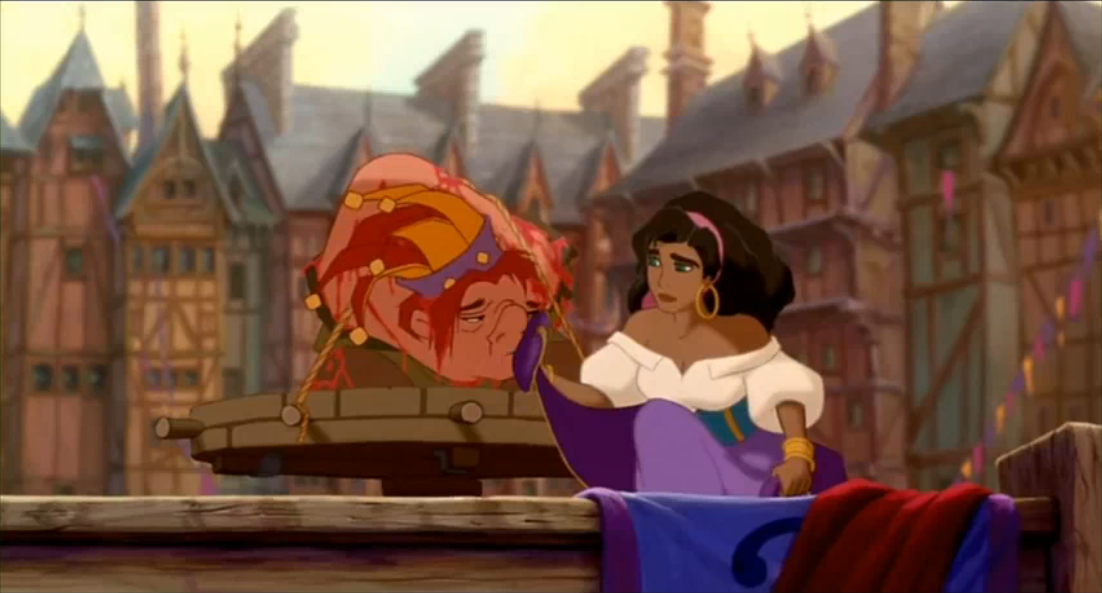
Esmeralda helping Quasimodo Disney Hunchback of Notre Dame
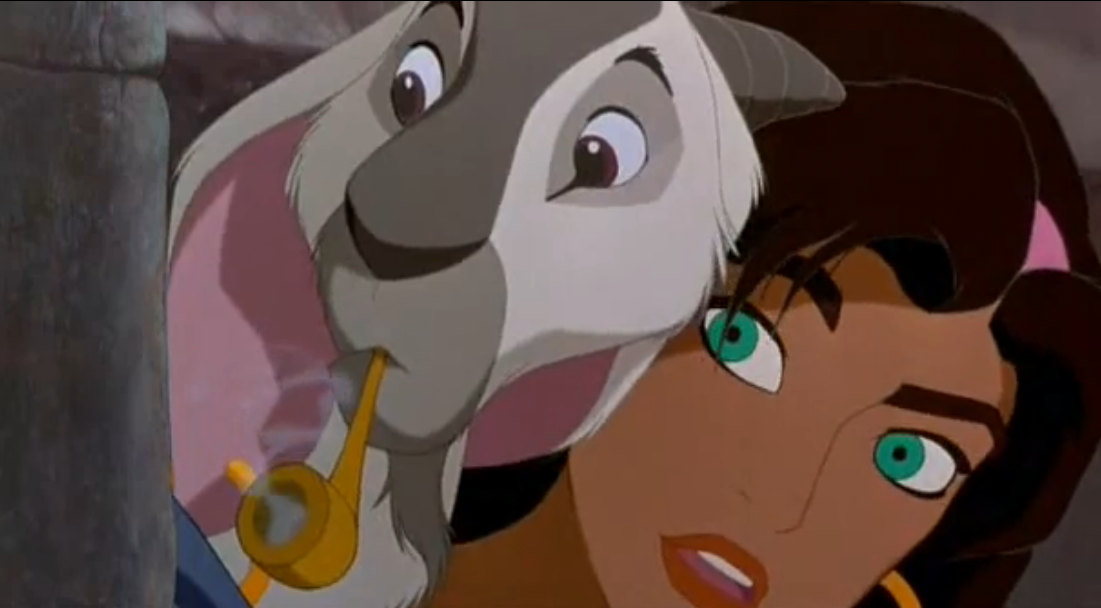
Esmeralda and Djali Disney Hunchback of Notre Dame
Esmeralda is a very different type of Disney Heroine, she’s mature and not a dreaming of new life. She deals with her lot in life and gets by the best she can. To make a income she dances.She also dabbles in fortune telling. She is also in the company or her goat Djali. Djali acts are her security system, warning her of danger and trying to protect her from would be harm. In the Disney version, Djali doesn’t get her into in trouble like in book. Infact Djali helps her get out of trouble by helping her deguise as an old begger man.
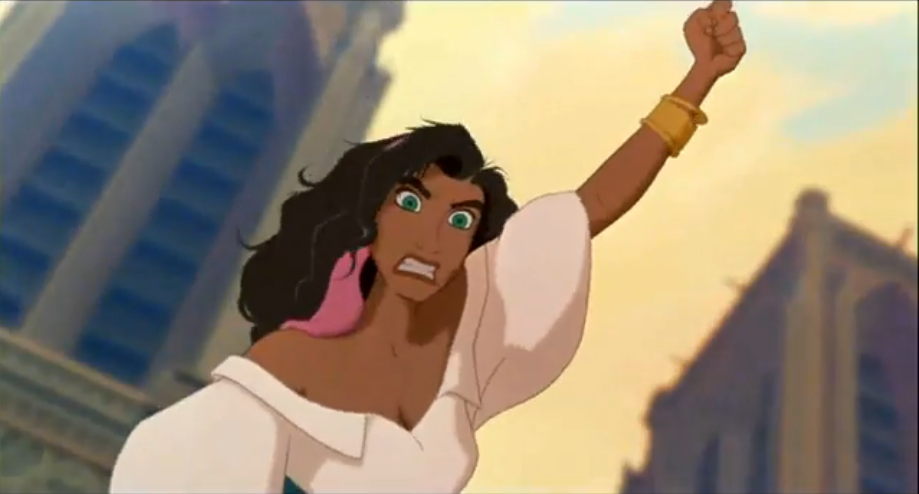
Esmeralda demanding Justice Disney Hunchback of Notre Dame
Esmeralda’s main motivation is social justice for mainly her own people but also for those on the outskirts of the social order (i.e. Quasimodo). It’s in this way she is the opposition of Frollo and she hates him and defies him every chance she gets. Prior to her defiance she teased/mocked him with her flirtatious dancing during the festival of fools. She also wary of those in power positions. That’s why she didn’t take a shining to Phoebus at first, but his persistent charm and wit won her over (plus saving an innocent family that almost cost him his life didn’t hurt much either).
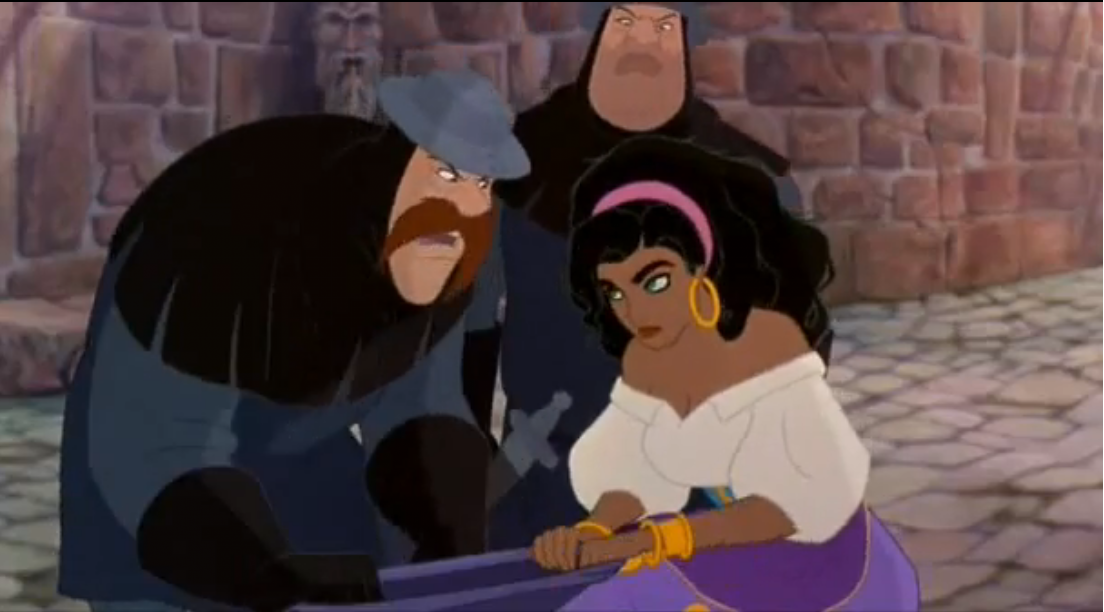
Esmeralda dealing with soldiers Disney Hunchback of Notre Dame

Esmeralda mocks Frollo Disney Hunchback of Notre Dame
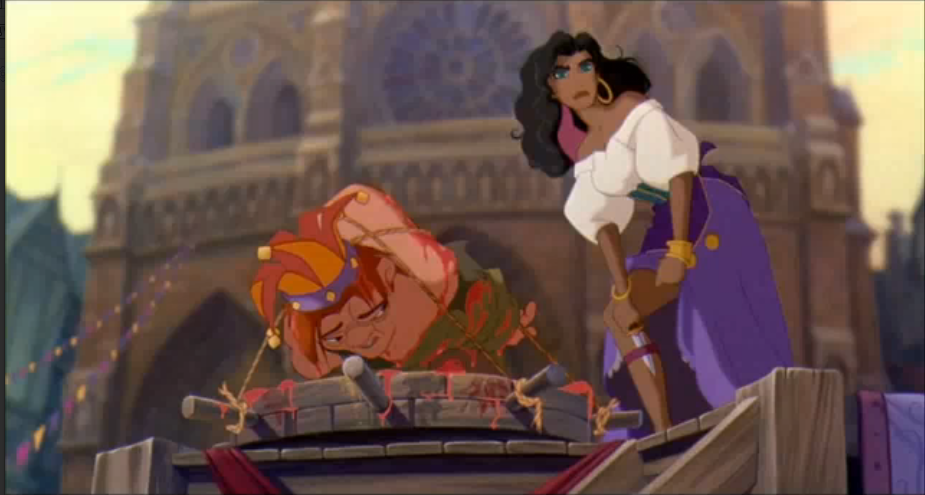
Esmeralda defying Frollo by helping Quasimodo Disney Hunchback of Notre Dame
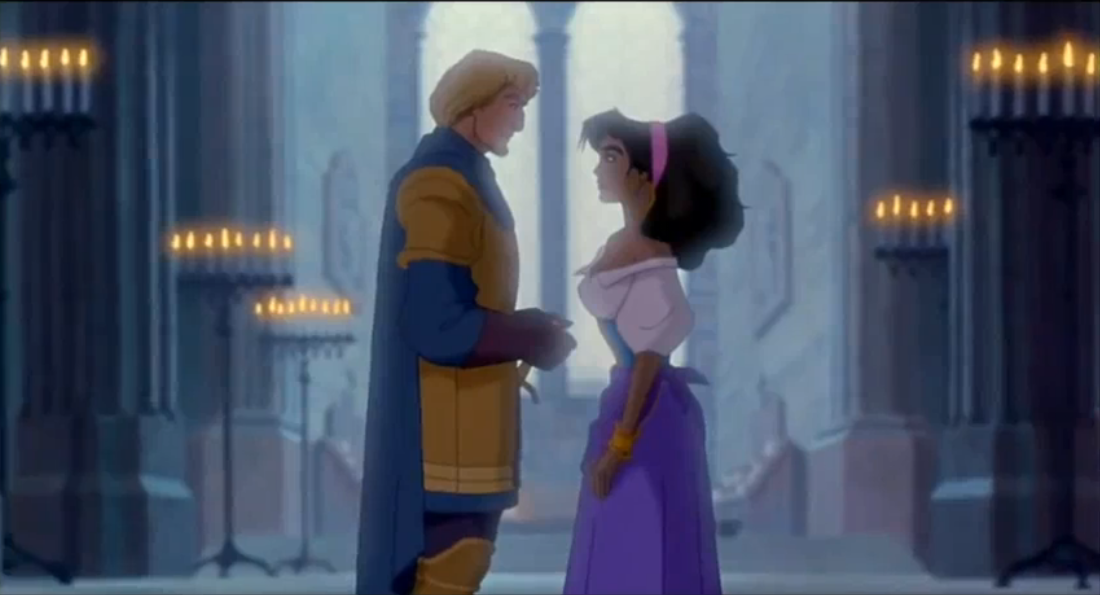
Esmeralda and Phoebus Disney Hunchback of Notre Dame
Speaking of Phoebus and Esmeralda here is a little point I would like to make. A few people feel that it was shallow of Esmeralda to choose Phoebus over Quasimodo. In movies, couples are usually established early, you can usually tell whose going to end up together. As a I mention in another post Esmeralda and Phoebus only have one scene without either Frollo or Quasimodo and that is where they are both introduced, meaning that their relationship was established before either of them met Frollo or Quasimodo. Also I can’t see Esmeralda and Quaismodo being anything but friends. She treats Quasimodo with kindness and politeness and comes off like an older family member; she really does treat him with kid gloves. There is no passion unlike Esmeralda and Phoebus. The creators wanted a romance between Esmeralda and Phoebus and that what the movie worked towards.
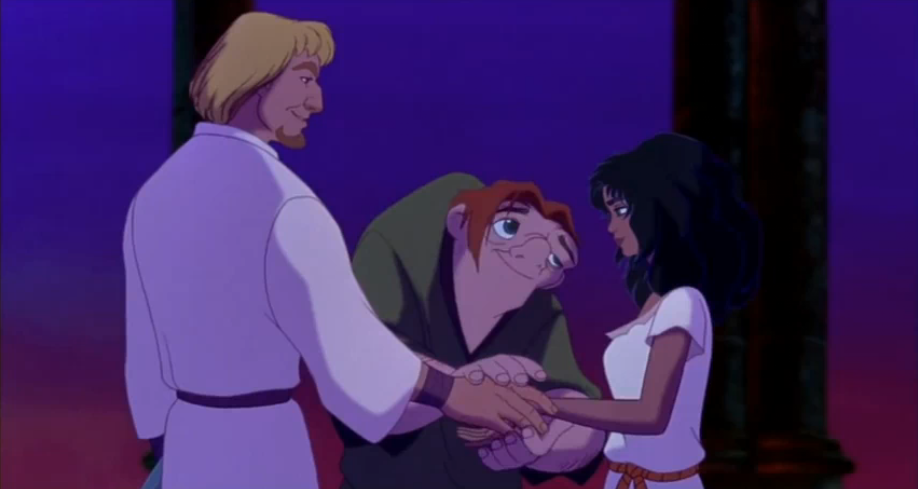
Quasimodo accepts Esmeralda and Phoebus as a couple Disney Hunchback of Notre Dame
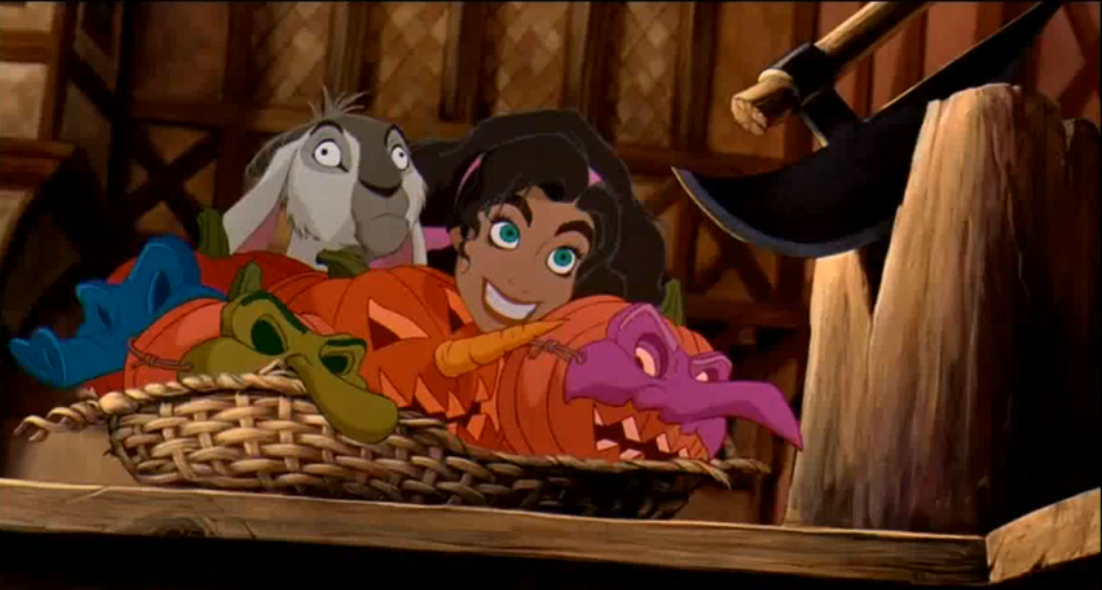
Esmeralda and Djali having a little fun Disney Hunchback of Notre Dame
As far of Esmeralda’s personality, she’s kind, she has a dry wit and she’s loyal to her friends. She is very resourceful, for example Phoebus owns his life to her make-shift sling shot that saved him from decapitation. She also has a bit of mischievous streak. During the chase after she frees Quasimodo she looks like she is legitimately having fun avoiding arrest while raising some hell. She also uses her feminine charms to get what she wants. She uses it to earn money from dancing but she also gives Quasimodo a peak on the check to get him to allow her to visit him. She is very physically fit; she dances, very agile in a fight (or chase), she can swim underwater, hold her breath long enough to get Phoebus out of his armor and pull up in record time. She also has seems to have some sway in the Court of Miracles as she can stop executions
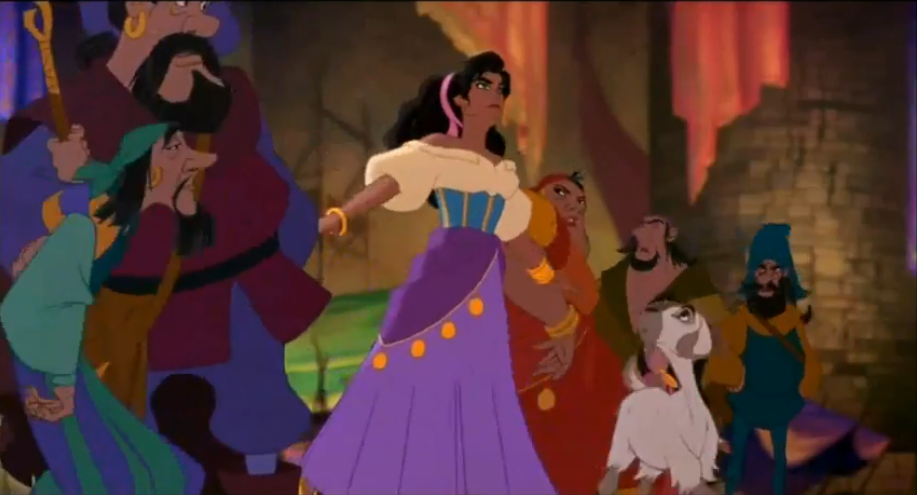
Esmeralda exerting some power Disney Hunchback of Notre Dame
and order the people to leave. She also can seem to refer people to the Court, not sure if that map/cryptic instructions she gave Quasimodo are standrad issue in the Court of Miracles or if she is some high rank there. Not only that but the other Gypsies wouldn’t devalue her location, meaning either they’re loyal to their fellow gypsies or she is respected. She also seems to have a close relationship to Clopin who like in the book is leader in the Court of Miracles. She performs with him and he not put off with her meddling in the hanging of Quaismodo and Phoebus, which Clopin seem to be enjoying. It seems to me that she must hold some power amongst her people or the Court of Miracle is egalitarian.
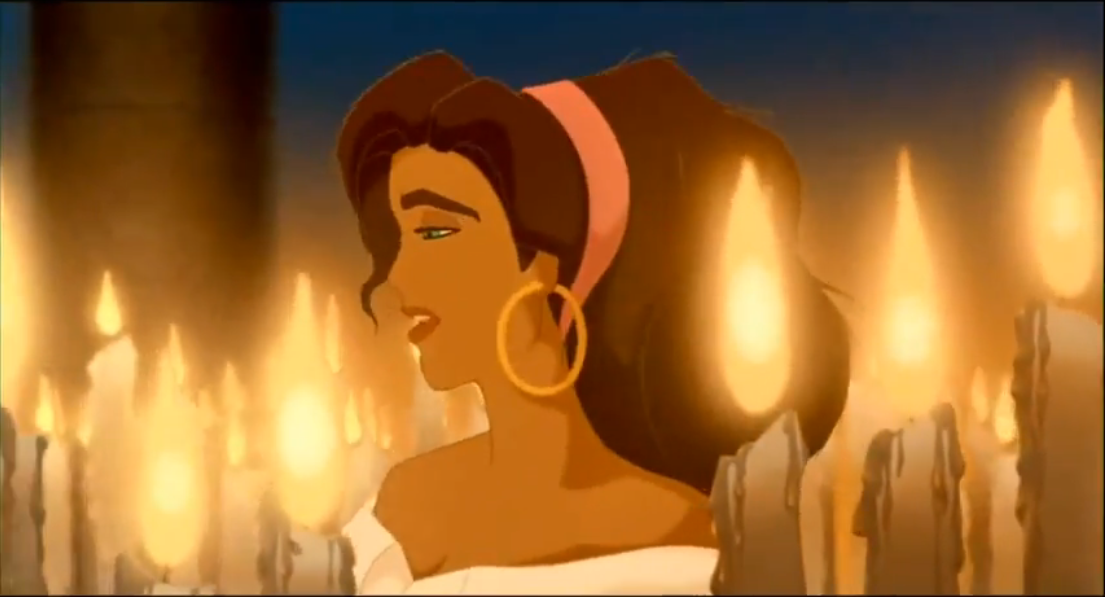
Esmeralda singing “God Help the Outcast” Disney Hunchback of Notre Dame
Esmeralda is not a dynamic character. She remains consistent throughout the movie; she’s mature, self-confident and kind at the beginning and she remains that way thoughout the end. The only aspect about that changes is her feelings towards Phoebus. In defense of static characters, Esmeralda is not a dynamic character in the book either and Disney doesn’t do dynamic characters very often.
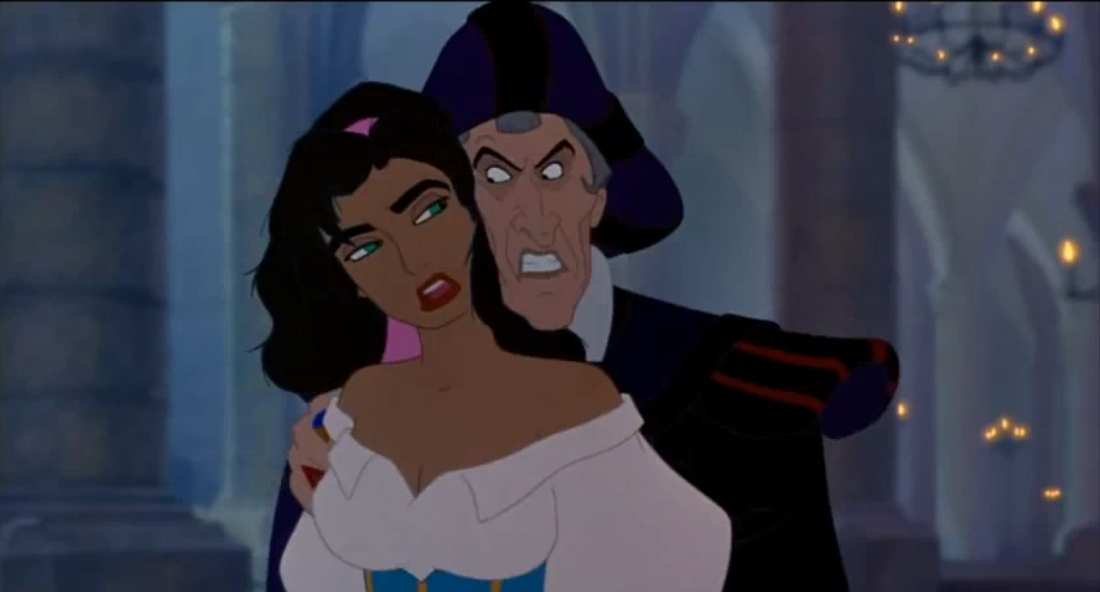
Frollo gropes Esmeralda Disney Hunchback of Notre Dame

Esmeralda avoiding Frollo’s hunt Disney Hunchback of Notre Dame
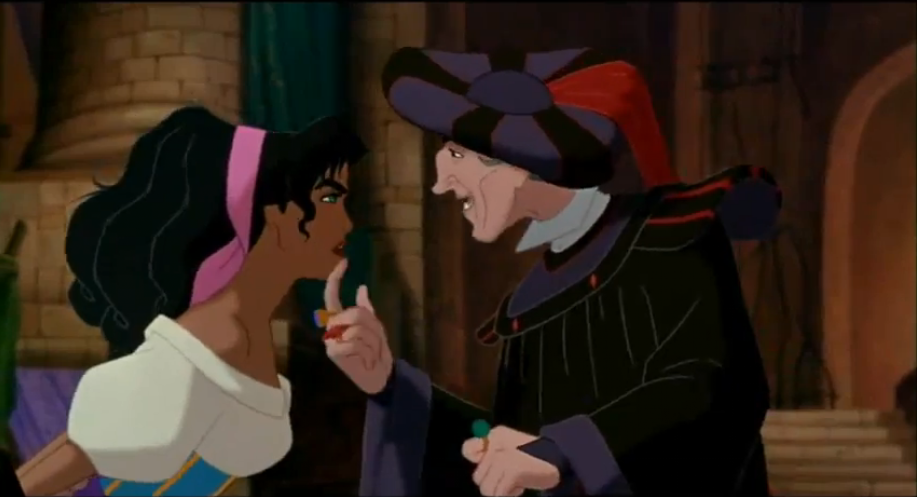
Frollo arresting Esmeralda Disney Hunchback of Notre Dame
Esmeralda is not a typical heroine, the scarps she gets into are serious. She’s almost arrested, assaulted in a church, threaten, hunted down by a control-freak mad man, almost burned, nearly dies of asphyxiation and then chased with a six foot sword a top a massive edifice. Makes other Disney heroine’s tribulations look like a child’s play. All she really did to get into all that trouble was being a Gypsy and a defing a powerful public offical; she stayed in trouble because of her beauty and sex appeal.
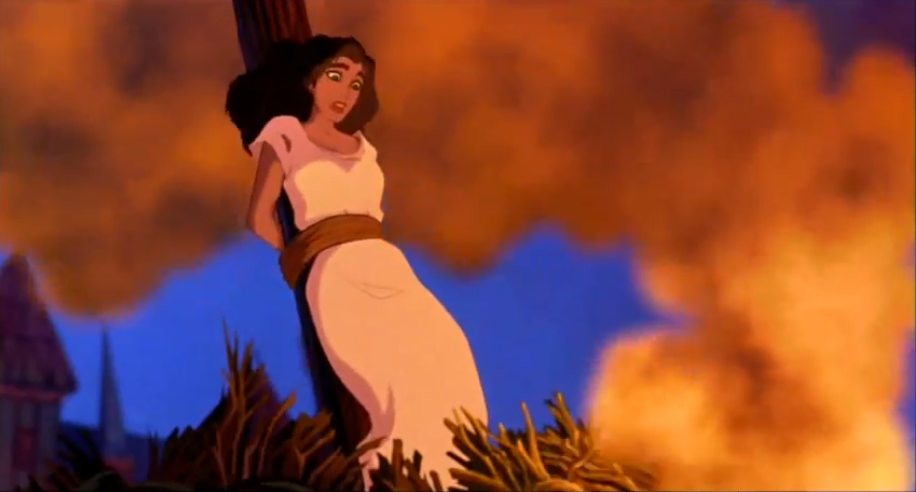
Esmeralda on the stake Disney Hunchback of Notre Dame
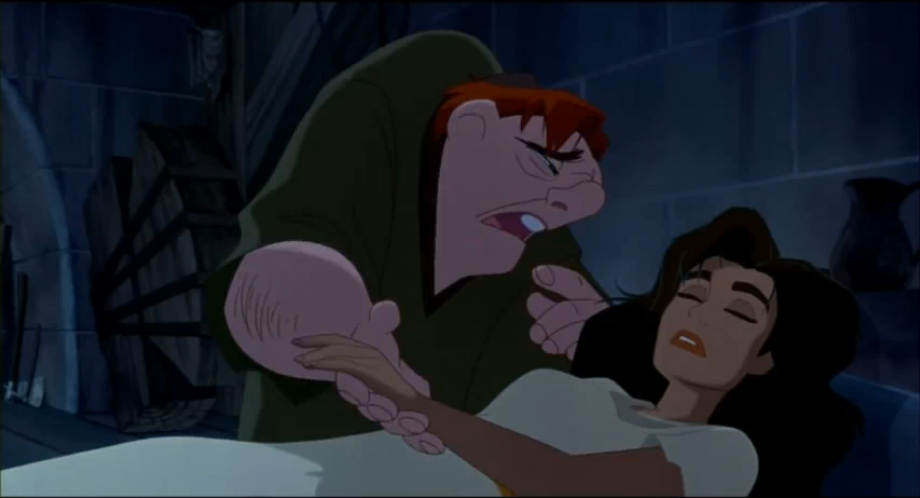
Quasimodo thinking Esmeralda has died Disney Hunchback of Notre Dame
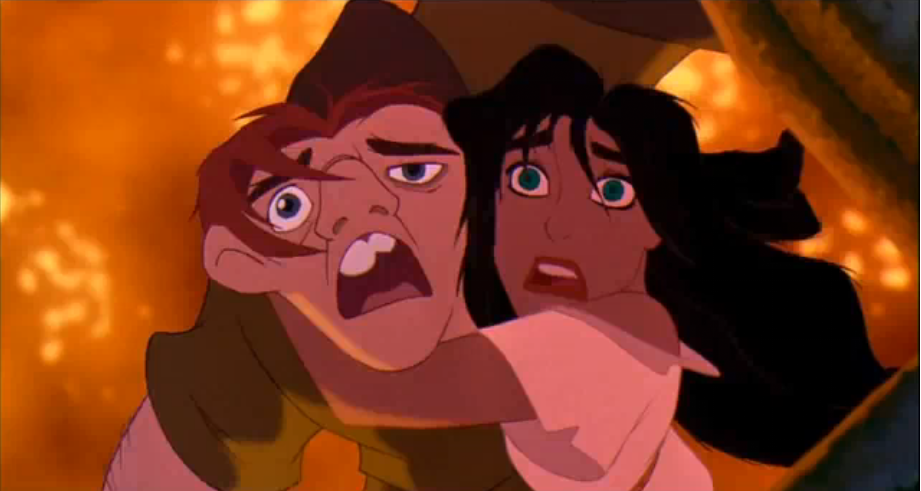
Esmeralda and Quasimodo being threaten Disney Hunchback of Notre Dame
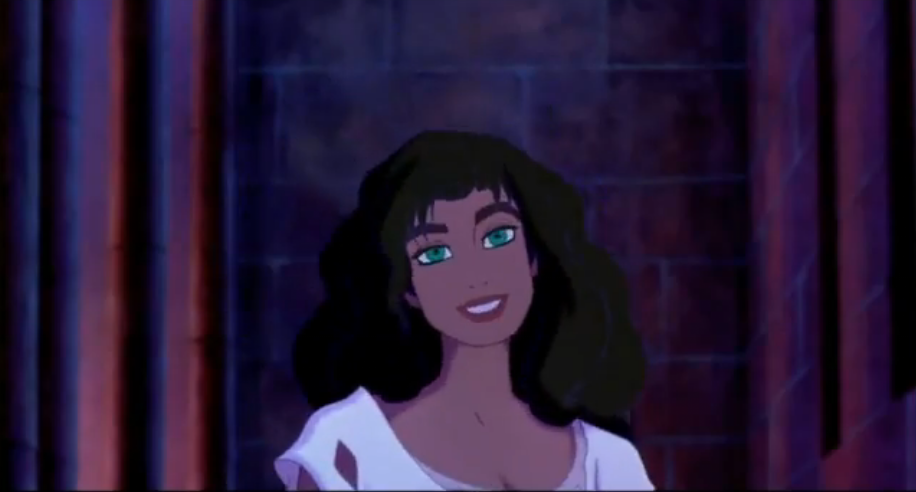
Esmeralda Disney Hunchback of Notre dame
I admit it was refreshing to see a different type of heroine when I first saw the movie in 1996 and it’s great that Disney ventured outside the profitable typical Disney heroine. If Hunchback had come out before this shift in heroine Esmeralda could have easily fit into the Disney princess line. Now if your thinking “Esmeralda’s not a princess” well I would say neither is Mulan but let me explain some minor points. The Disney Princess brand isn’t actually about the characters being princesses it’s about how their movies did with girls in a certain age demographics, hence why Esmeralda isn’t in the line up already. But if Esmeralda behaved more like Ariel, Belle, or Jasmine (dreamer wanting more) she may have done better with young girls, though it’s hard to say. I suppose the creators thought Quasimodo fit dreamer model better than Esmeralda and she would do better as an agent of Quasimodo’s liberation from being a focused shut-in. But another point worth mentioning is Esmeralda in the book fits the Disney princess mold very well and she was very well regarded in the Court of Miracles. So making like a princess wouldn’t have been a stretch and she does dream of a different life with regards to Phoebus. I wonder if Disney regrets this since the Disney Princess line was establish in 2001.
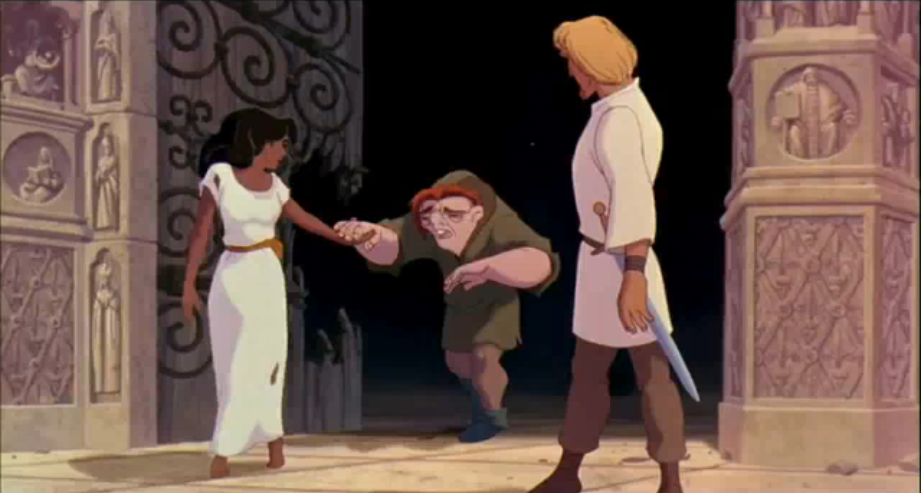
Esmeralda, Quasimodo and Phoebus leaving Notre Dame
Next Character –Phoebus
Phoebus Disney Hunchback of Notre Dame
Next up the Villain: Frollo

Judge Claude Frollo
Frollo is Quasimodo’s counterpoint and the Villain of the movie. Frollo is a bit different from other Disney villains. Many of the villains are trying to get more power (Ursula, Jafar, Scar etc), Frollo already has Power, he is the High Justice of Paris. His motivation keeping control and he is fueled by hate. He thinks he’s better than everyone else from a moral stand point and if he judges it as amoral than he thinks he is in the right, from killing an innocent women, to trying to kill a baby, burning Paris or attempted genocide.

Judge Claude Frollo
Disney villains generally have two looks to them, elegant and slim or fat yet still elegant. Frollo is of the elegant, slim and tall variety. Looking at the concept art you can see parallels between Disney’s Frollo and Sir Cedric Hardwicke. He dresses like noble but
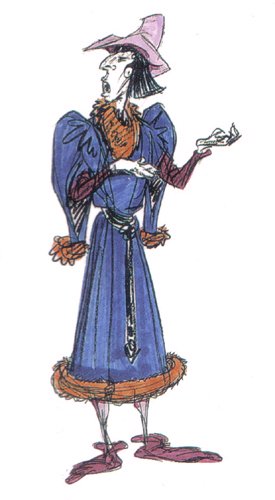
Concept Art for Frollo
we’re given no back story other than his relationship with Quasimodo so we have no where he comes from. In the musical Der Glökner von Notre Dame ( German musical by Alan Menkan based on the Disney movie) Frollo was a priest prior to becoming the high Justice, which makes his pious-bent makes a little more sense, but you don’t go from a priest to High Justice. At least in 1939 version his piousness was the result of having a Brother who was the Archdeacon. With Disney Frollo there is no hint or reason given for a morally-corrupt pious Judge. You can make guesses as to what the reason is for Frollo’s behavior but Disney films have never been a venue for giving out much character development of their villains. Character Development might prompt sympathy. My Guess would be being pious and acting moral helps Frollo maintain his hold over the Parisians.
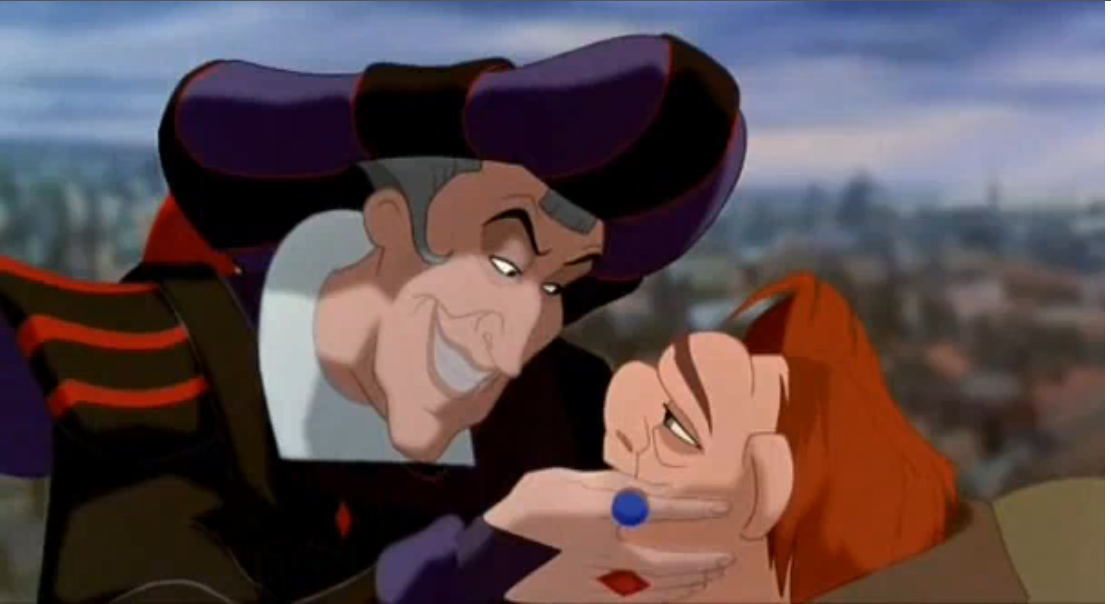
Frollo and Qausimodo
Frollo is very conniving and manipulative. He raises Quasimodo out of guilt for killing Quasimodo’s mother in front of Notre Dame but he keeps him locked away in Notre Dame. I can’t quite figure out his logic for keeping Quasimodo in Notre Dame (other than the almighty plot and source material told him to), I mean Frollo lives in a jail. Anyway Frollo also raises Quasimodo with the hope that Quasimodo will be useful to him in some capacity. It’s hard to know if Frollo actually likes Quasimodo or he simply likes the dynamics of their Master/slave:Father/son relationship. My guess is Frollo all about Power and keeping power and Quasimodo serves as a consistent reminder of his hold over Paris and when Quasimodo proved too willful for him he tried to kill him.
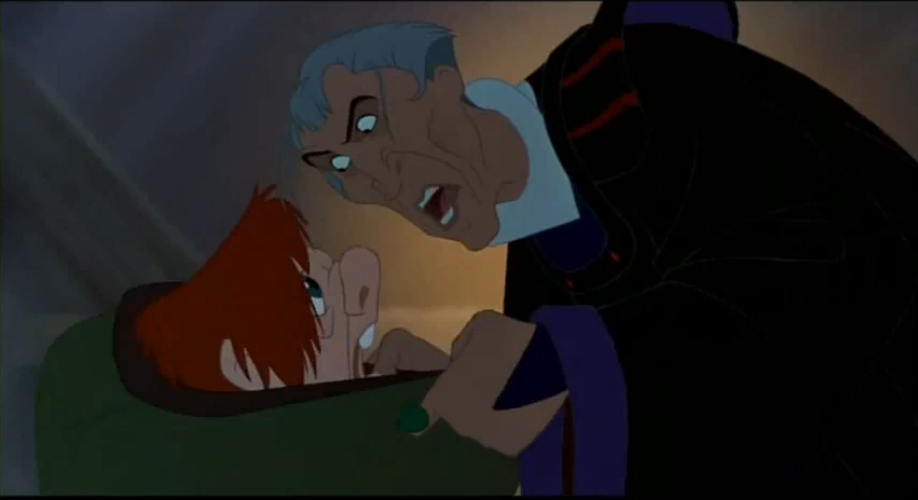
Frollo trying to control Quasimodo
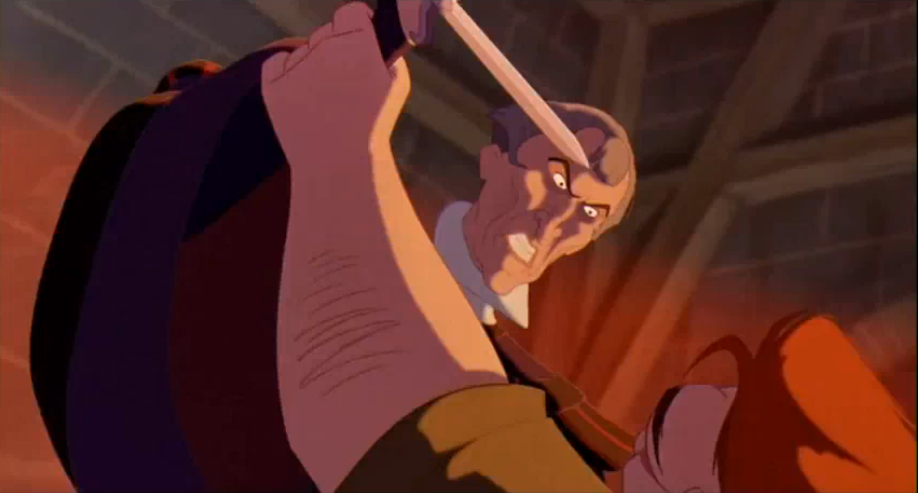
Frollo trying to kill Quasimodo
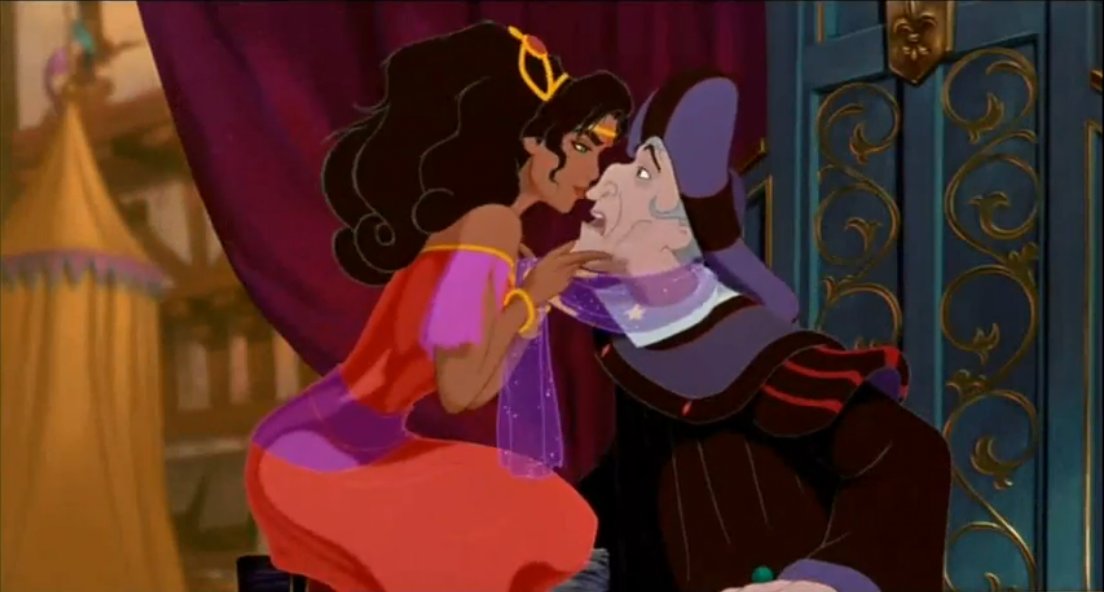
Esmeralda giving Frollo a Kiss
In direct opposition to Frollo’s control is Esmeralda. Esmeralda is everything that Frollo hates, she’s a free-spirited Gypsy who dances and lives outside the social order that he controls. Frollo first notices her when she danced a very sensual dance and kissed him on the nose. The dance, while getting his attention wasn’t the factor to make him obsessives towards her, it was her defying him in support of Quasimodo who was being tortured by the crowd. Esmeralda uses some parlor tricks that Frollo misconstrues as witchcraft (another of Frollo’s turn off) and after a merry chase she gives him the slip

Frollo groping Esmeralda
and goes into Notre Dame. Frollo’s obsession for her intensify to the point where he has to over come her, at this point by arresting her. Frollo tries to arrest her in Notre Dame but due sanctuary, she is protected. It’s at this point Frollo loses control and gropes her, and sniffs her hair, and thus the lust begins. As he can’t arrest her, he blocks her in Notre Dame stationing guards at every door of the cathedral. Frollo then sings about how his losing control is the fault of Esmeralda and not his (Hellfire). At this point arresting Esmeralda is not enough, he needs to be in possession of her or she mustn’t exists. It’s
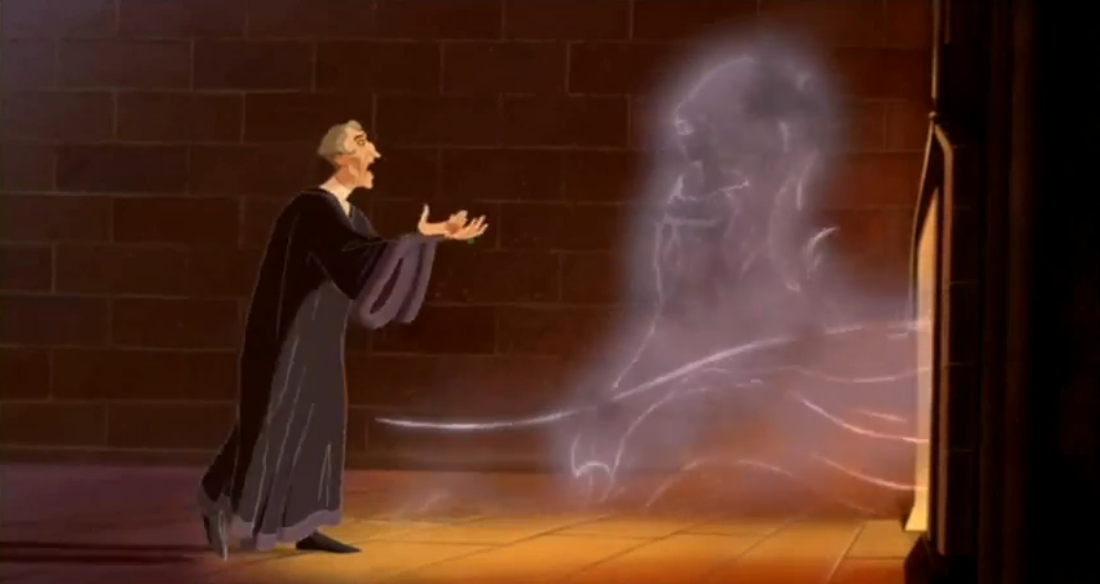
Frollo and an illusion of Esmeralda during Hellfire
during this song where he learns that once again that Esmeralda has given him the slip. Frollo then goes on a spree of burning Paris, trying to bribe other Gypsies for Esmeralda’s whereabouts and then arresting them for not being helpful. Frollo manipulates Quasimodo to learn the

Frollo’s ultimatum to Esmeralda
location of the Court of Miracles. This is where Esmeralda is when Frollo attacks and arrests everyone there. As Esmeralda is tied to the stake and about to be burn, Frollo gives Esmeralda his final ultimatum, (him or Flame). Ultimately, like all Disney movies there is a climax that ends with the villain’s death, like many Disney movies, Frollo is not killed or subdue by the hero, he’s actually about to kill Esmeralda and Quasimodo but the gargoyle he is standing on breaks and Frollo falls to his death. So the real hero of the story is Notre Dame.

Frollo’s Death
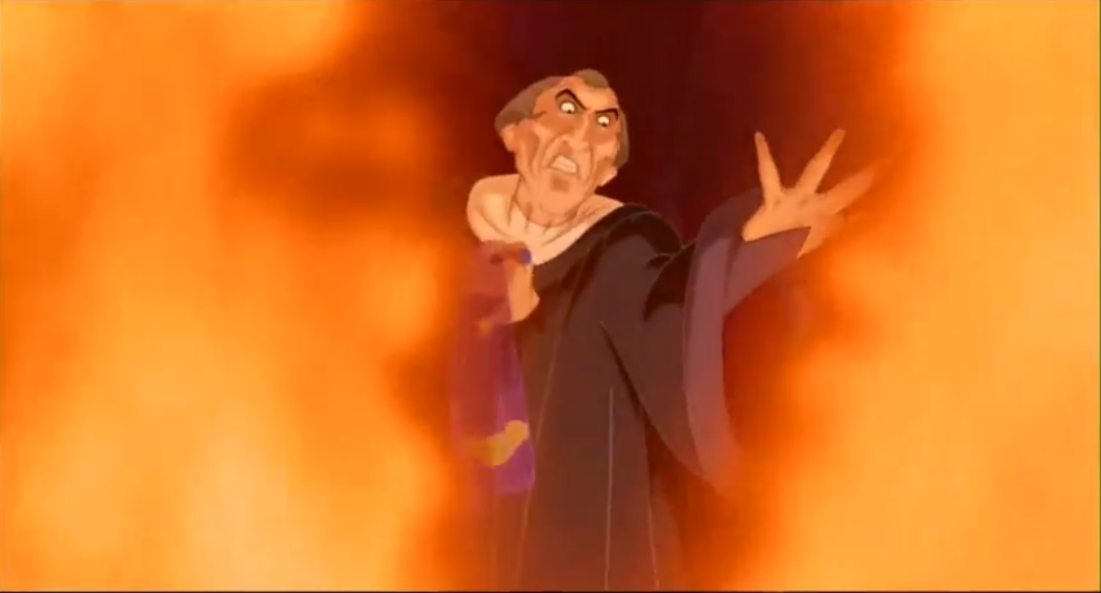
Frollo singing Hellfire
So in the history Disney of Villains, Frollo is one of the favorite. Nostalgia Critic and Nostalgia Chick from the immensely popular website Thatguywiththeglasses.com, ranked Frollo as one of the best villains after The Chernabog from Fanastia and Mola Ram from Indiana Jones and the Temple of Doom, respectively. As far as Disney Villains go, he’s guilty of some of the most heinous acts. Within the first two minutes of his introduction, he kills

Frollo killing Quasimodo’s Mother
a women and tries to kill a baby, he shows no remorse for

Frollo attempting to drown baby Quasimodo
these acts, in fact he justifies them; the women ran, he just followed (he must have thought the kick was an act of God) and he justifies almost killing a baby because it’s ugly (ok he thinks it’s a monster, hey Frollo you’re no great beauty either). What makes Frollo more compelling as a Villain is his control and power and the fact that he thinks he both righteous and pure.
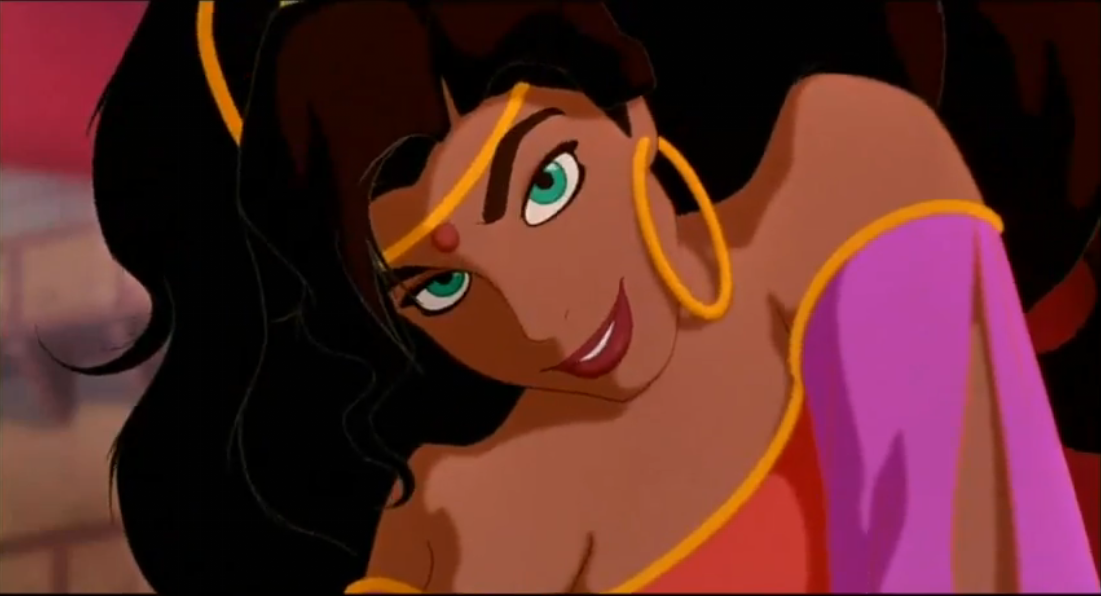
Esmeralda
So last time we looked at the Disney characters on a board level, now lets look at them on a deeper level.
Let’s start with the titular character: Quasimodo!
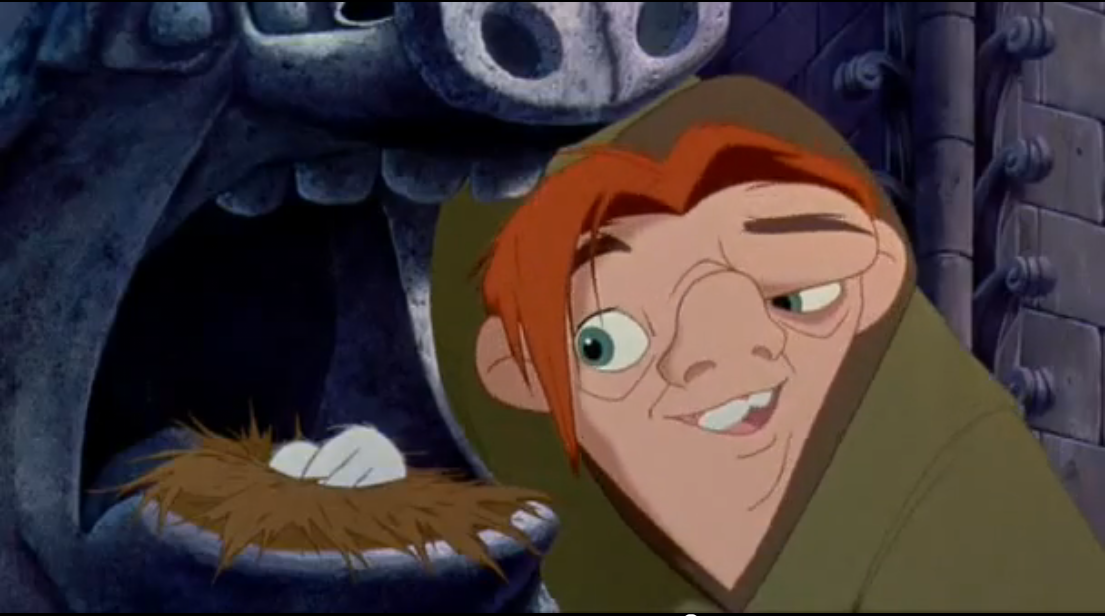
Quasimodo’s Reveal
Quasimodo may be told he is ugly and monstrous but if we compare him to his book counterpart, he is on the cute side of the monster spectrum. He’s a hunchback and he is shorter than most of the other characters, but that’ not enough to make him an isolated monster. He has the over-the-eye protrusion that Hugo described but it does not impair his’ vision to the point of being a cyclopes. Instead Quasimodo has big, friendly doe eyes. He has a red full head of head hair and wears a green tunic. Two of the more uglier factors are his big stub nose and his teeth (large teeth in the front of his mouth).
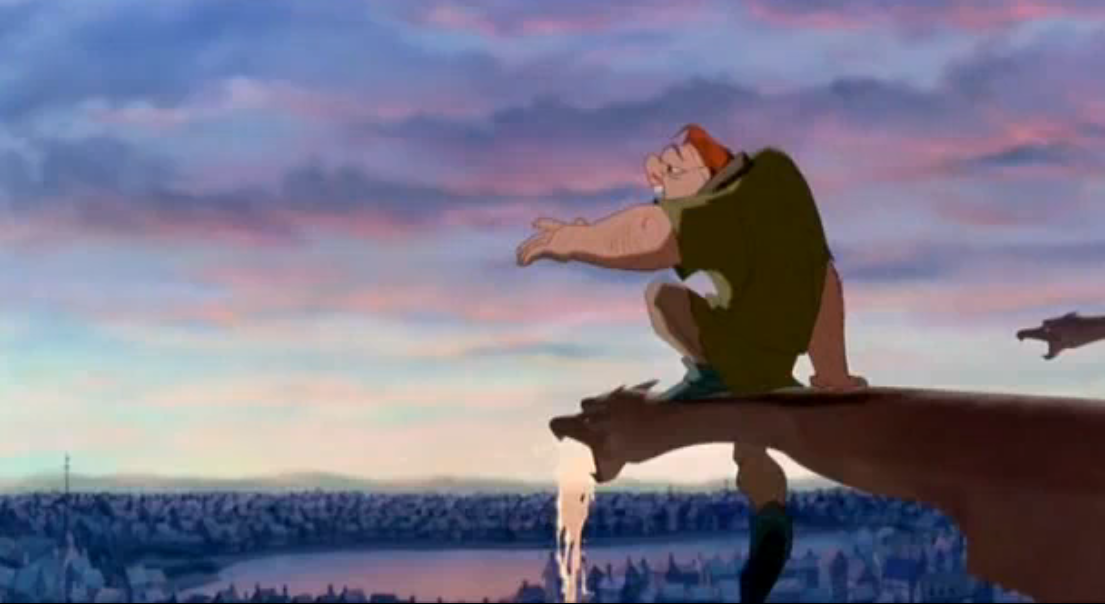
Quasimodo singing “Out There”
Unlike Hugo’s version, Quasimodo is not deaf, he sings and talks a lot but it being a musical it would have been a challenge for the directors to have a deaf hero who has to sing (Disney movie from the 90s, heros must sing), so it understandable why Quasimodo is not deaf.
Quasimodo’s personality in the Disney movie is completely different from the book. In the book Quasimodo is morose and angry. At the beginning of the book he only loves Notre Dame, the bells, and Frollo. He’s not interested in being among the normal people of Paris nor is he forbidden from going out among them. Disney’s Quasimodo is forbidden from going outside and all he wants is to spend one day of his life among the normal people.
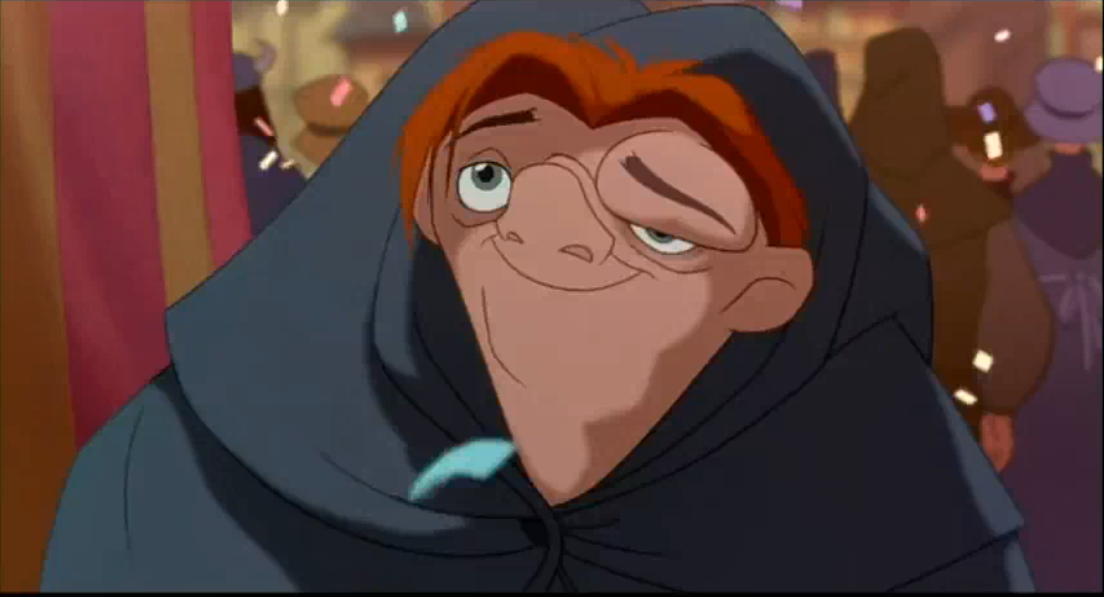
Quasimodo gazing at Esmeralda
As the story progresses he falls in love with Esmeralda. In the Book, he falls in love with her after she shows a little kinds and pity by giving him water when he is on the pillory for trying to kidnap her because Frollo ordered him. That simple act was what did it for him, not her dancing or her looks. In Disney again Esmeralda shows him kindness but when he first meets her, she was kind to him and complimented his ugly mask (really his face) and Quasimodo likes the positive attention. He see her dance and he likes it.
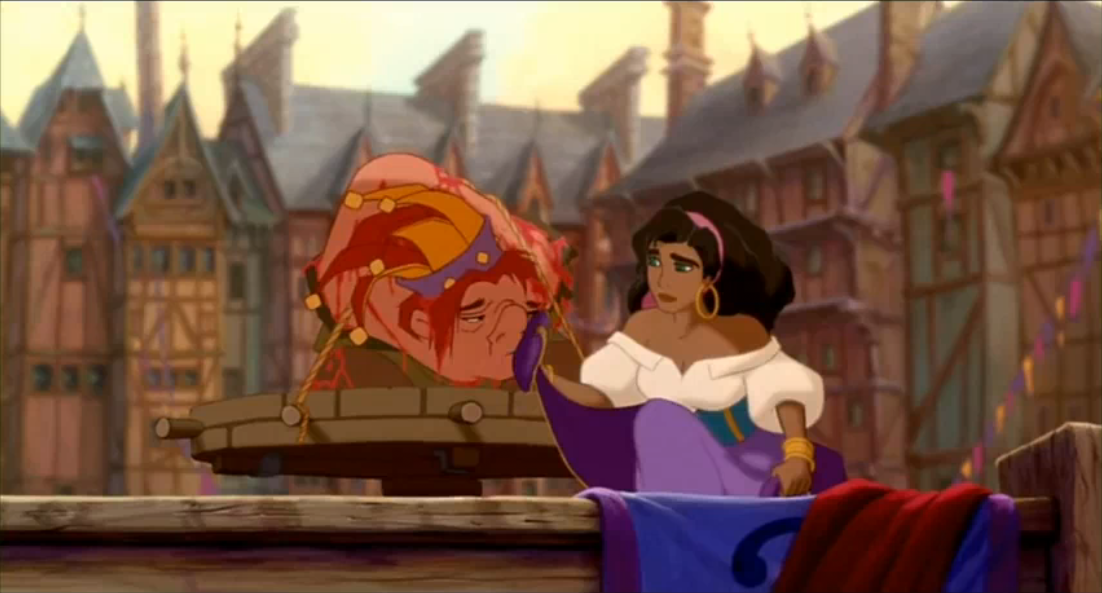
Quasimodo and Esmeralda on the pillory
When Quasimodo is being tortured by the crowd at the Festival of Fools, she does save him but he was already interested in her, but I guess maybe that sealed his “love for her”. The Disney Quasimodo’s love is more manifested as a school boy crush than a deep connection and I don’t believe he would crawl into vault and to die next to her rather than live without her.

Quasimodo’s figurines from “Heaven’s Light”

Quasimodo declares Sanctuary for Esmeralda
It’s sweet that he believes that she could love him whereas in the book Quasimodo doesn’t believe it, even if he wishes he could. Quasimodo is mostly depicted as kind and gentle. He gets depressed but it never lasts too long. He’s also loyal which I think is the biggest similarity to Hugo’s original character.

Frollo and Quasimodo
Quasimodo is a dynamic character. He changes though the course of the movie, mainly in his attitude towards Frollo. At beginning he is nervous around Frollo even though he believes Frollo to be his defender. His nervousness around Frollo stems from Frollo’s abuse towards him. Frollo calls him ugly repeatedly and a monster. When Frollo comes to visits him, Frollo gets a silver goblet and plate while Quasimodo get a wooden goblet and plate. Frollo keeps him locked up in bell tower of Notre Dame while Frollo dwells elsewhere, you’d think the Palace of Justice would be a better place to lock one up forever, it being a jail instead a public building. I would like to point out in the book,
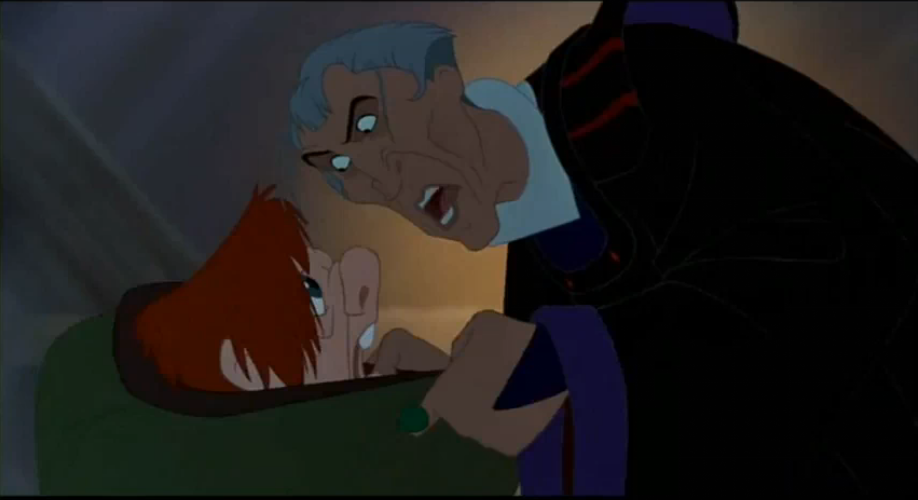
Frollo and Quaismodo
Frollo keeping Quasimodo at Notre Dame made sense as Frollo himself lived in the cloister as he was a priest, Quasimodo didn’t move to the Bell Tower till he was 14 years old. He moved there to be the bell-ringer because he loved the bells, not as punishment for his deformity or as method for absolution for Frollo. Quasimodo calls Frollo master but Frollo insists that he raised Quasimodo as his son. Quasimodo would probably be fairly well adjusted if it wasn’t for Frollo. Quasimodo then disobeys Frollo and goes to the Festival of Fools to fulfill his dream. He continues to disobey Frollo as he gains real human interacts with Esmeralda and Phoebus. At the end he stands up against Frollo and learns that people like Frollo are the cause for all the hate in world and once Frollo is dead he is finally accepted by the people.
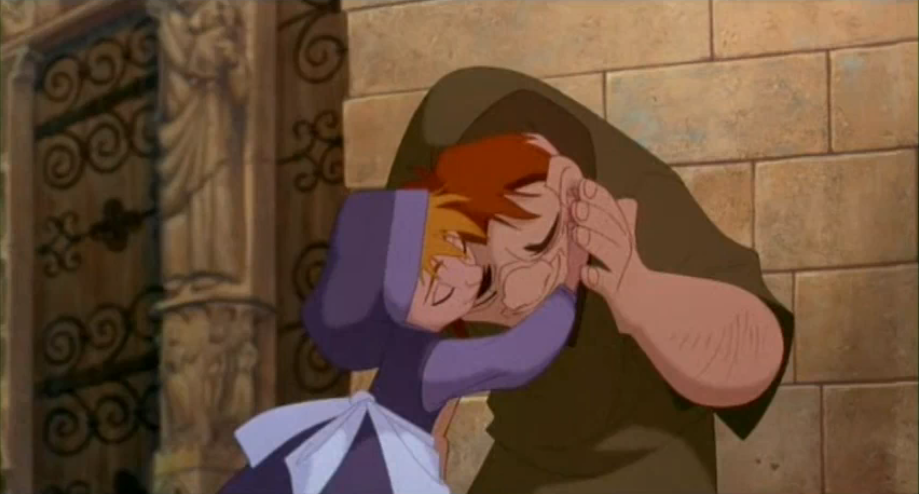
Quasimodo accepted by the people
Despite being in the Disney mold of hero/dreamer, Quasimodo is good character, he appeals the outsider in all of us. The film is good achiving it’s overall theme though Quasimodo despite being thrust upon the audience, but at least he is likable and grows as character.
Next time we’ll look at Frollo.
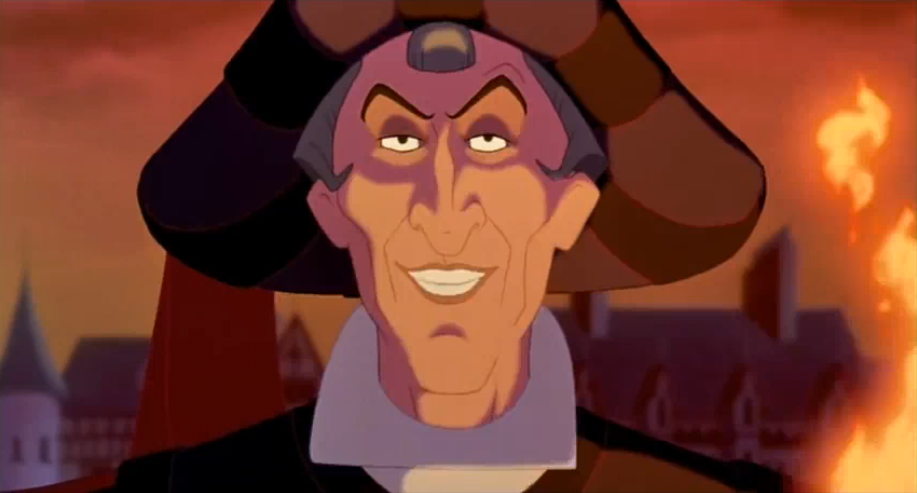
Judge Claude Frollo
Quasimodo’s Reveal Hunchback of Notre Dame Disney
The plot of the Disney’s Hunchback of Notre Dame is a water-down and condense version of Hugo’s novel and the 1939 version. Because the film is for children the film couldn’t follow it 100% or even 75% so watering it down is understandable. To the film’s credit it did opt for a darker tone than most Disney movies especially where Frollo is concerned. And for the record there are worse children adaptions and as it stands, it is the best among the Hunchback for kids movies.

Victor, Hugo and Laverne singing A Guy like you Disney Hunchback of Notre dame
So the plot is stripe down to it barest essentials with a lens on Quasimodo and add-ons from the 1939 version. They added a moral, eliminated some characters (Gringoire, Jehan, Louis, Sister Gudule (who is hardly ever mention in the adaptations) and added some characters (The gargoyles).
Esmeralda Disney Hunchback of Notre Dame Dancing
The basic plot is really about a cute girl and the guys that “love” her and where these men take that love into their psyches. That’s Hugo’s book at it’s most basic level, the problem is that since this book was published in English the focus has been take off Esmeralda (Notre Dame de Paris) and went to Quasimodo (The Hunchback of Notre Dame). And to make it worse, two of the most famous “Hunchback” movies from the golden age of cinema, were vehicles for leading man playing Quasimodo. So the movies really do think that Quasimodo has to be the focus of the film and Disney really bought into this mentally (listen to DVD commentary).
Frollo and Qausimodo Hunchback of Notre Dame Disney
So the Disney plot lies in the moral that Quasimodo inspires, sure he ugly as all hell but he’s beautiful on the inside, and that’s what the plot is trying to teach, don’t judge people. A corrupt, yet pious Judge can still be a an evil jerk. Of course, this moral is as subtle as a ton bricks and the scenes can never shift away from Quasimodo for too long unless it’s a counterpoint to how great he is, and that would be how terrible Frollo is. So Frollo can gets just as many songs and srceen time as Quasimodo. This is why you’ll only see one scene without either Frollo or Quasimodo, which is Phoebus and Esmeralda’s introduction, you could count their time in Notre Dame but Frollo is technically in that scene and since there no cut in locations Quasimodo is there too . That scene of Esmeralda in Notre Dame speaking with Phoebus, getting grope by Frollo, and singing God help the Outcast ends with her following Quasimodo to the bell tower, so it doesn’t really count. So there is only one scene without Quasimodo or Frollo. The plot lives and dies on Frollo and Quasimodo and so the film’s moral is ALSO being referenced during the film’s duration. Even the songs act a method to reference the moral. All of Quasimodo and Frollo’s song are linked by this man vs monster prespective. Clopin is the only character who gets some songs with any levity.
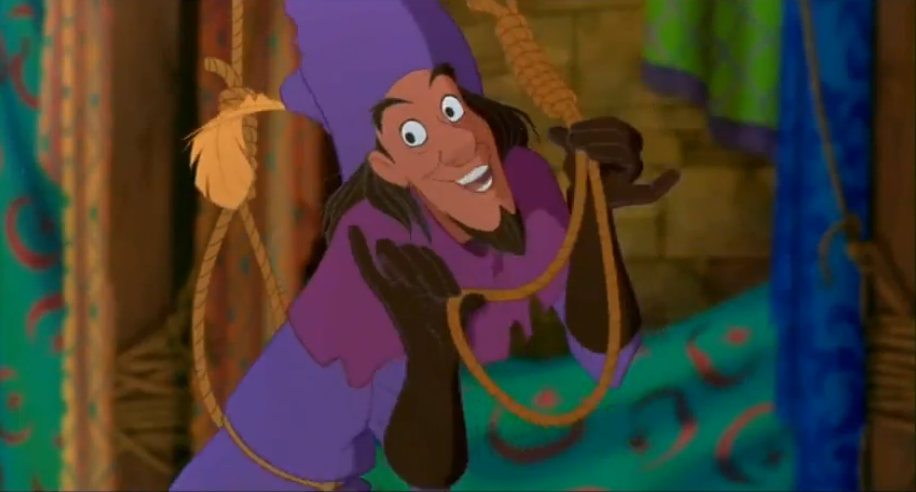
Clopin Disney Hunchback of Notre Dame

Phoebus, Quasimodo, Esmeralda Disney Hunchback of Notre Dame
So how was the plot of Disney’s Hunchback? Despite the film’s tunnel view of not giving a character that isn’t Quasimodo or Frollo 5 minutes of screen time. the film’s plot does well. It keeps the overall feeling of the story and makes it kid friendly and that was Disney’s angle and yet gives it a darker edge which help roots the film in Hugo’s book. But the book and the Disney’s version are character driven and not as plot driven so next time let look at the Disney version of Hugo’s characters.
Next time – a brief look at the Characters of Disney’s Hunchback of Notre Dame
So after looking at the plot overview let’s review it. The first thing to look at is the script. The script of 1939 version of the Hunchback of Notre Dame was written by Bruno Frank and Sonya Levien. Frank wrote an adaptation and Levien wrote a screenplay based off that adaptation. The thing to keep in mind about Frank’s adaptation is that he was a German author, poet, dramatist and humanist of Jewish descent. He fled Germany because he feared the Government and lived in Austria and England before going to America in 1937. He then starting working in Hollywood as a writer. So given the political environment of the late 30’s along with Frank’s experience it’s no wonder that the Hunchback of Notre Dame parallels Europe of the late 30s. Considering Frank’s background as an author/poet/humanist it’s understandable why Gringoire is co-hero with Quasimodo.
Speaking of Quasimodo and scenes that feature him, most of his lines are pretty much verbatim to what Victor Hugo wrote. The film also likes to insert him wherever it can: Louis commenting on the Bells and asking about the Bell ringer, the girl crying to grandmother about seeing him, scaring Esmeralda away from Notre Dame, confessing to Phoebus‘ murder, and him alone at the end. Clearly the film compensates for Quasimodo isn’t the main character in the book.
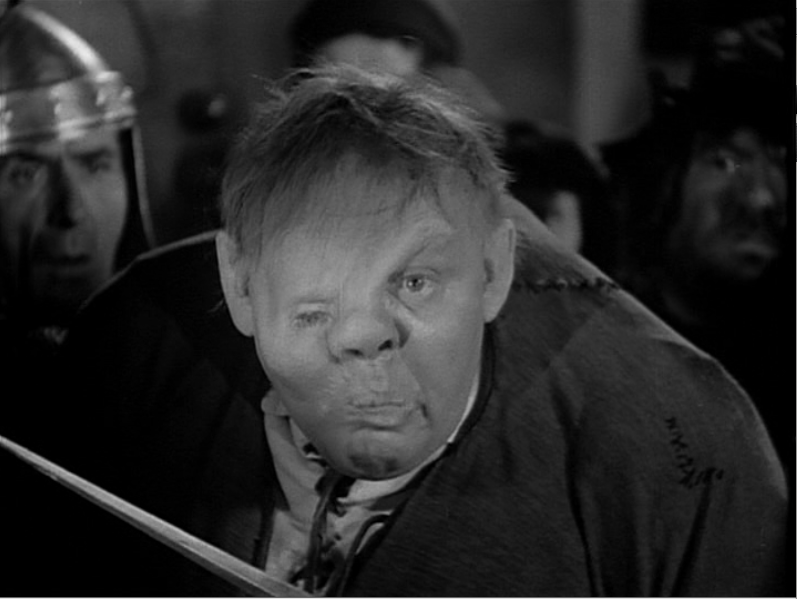
One of the major problems with the plot is that because there is this push towards modernity, which Louis and Gringoire represent, there are lot of scenes that are either completely added, like opening scene or added to much larger parts of the film so that Louis and Gringoire can be featured more. Quasimodo’s flogging and Esmeralda’s trial are good examples. The pillory scene cuts away to other characters and sometimes just random extras, but it mainly cuts to Gringoire and Clopin, who are talking about the truth about beggary and Gringoire wanting to help Quasimodo, so he prolonged in the scene further by seeing Claude. Esmeralda’s trial has interjects made by Gringoire pleading for common sense, Quasimodo confessing to the murder, and Louis giving Esmeralda a “Trial by Ordeal” the “ordeal” is more chance, basically she just has to touch the right dagger (Louis) to be freed but she fails. These add on don’t add much and if they accomplish anyway it weak character develop at best.

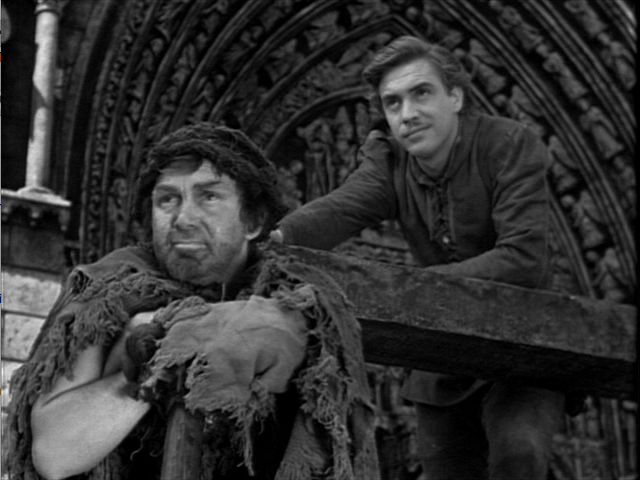
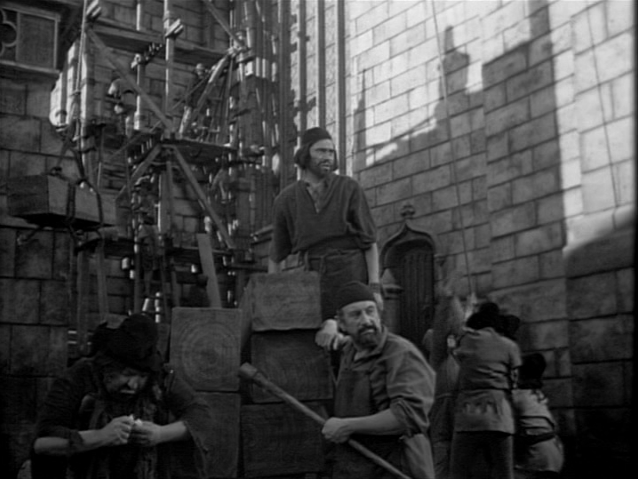
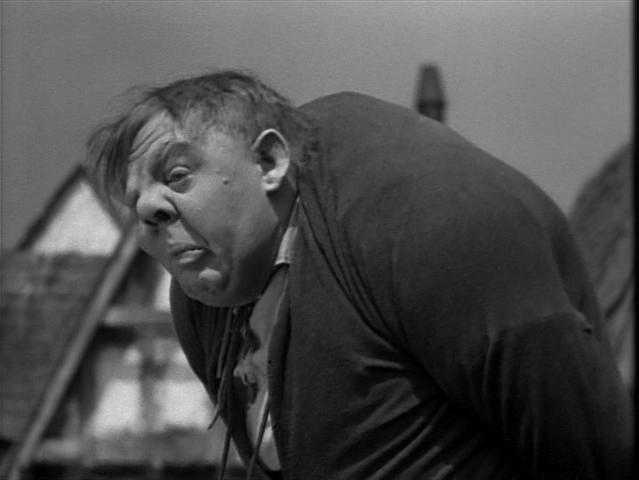
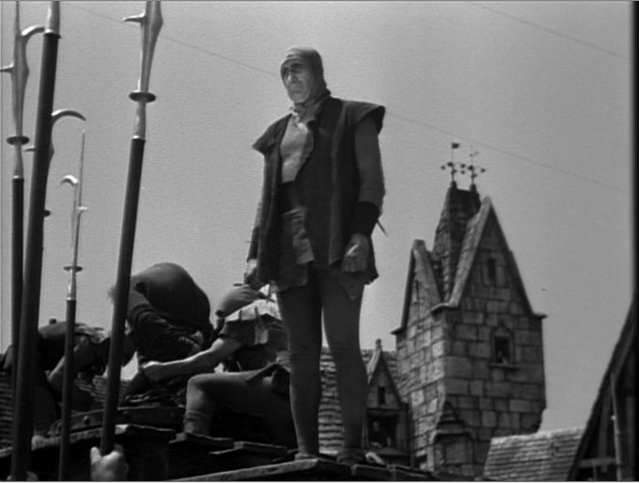
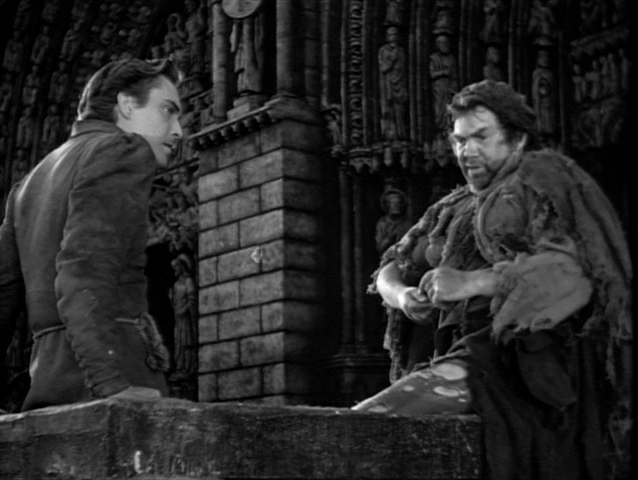
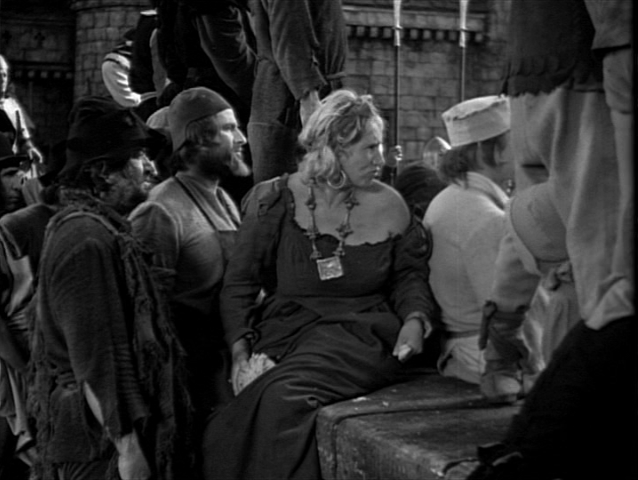
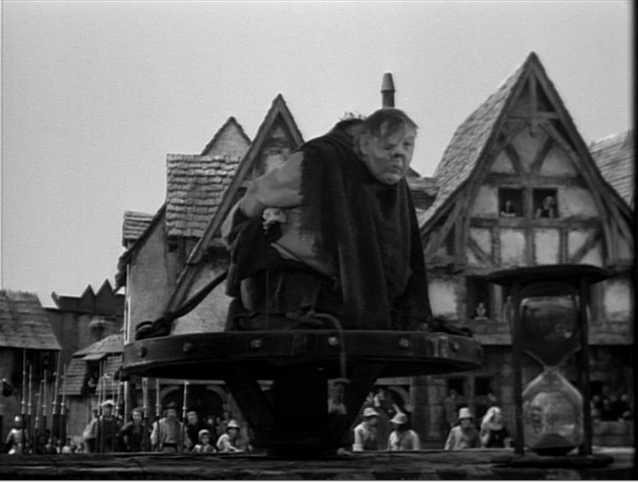

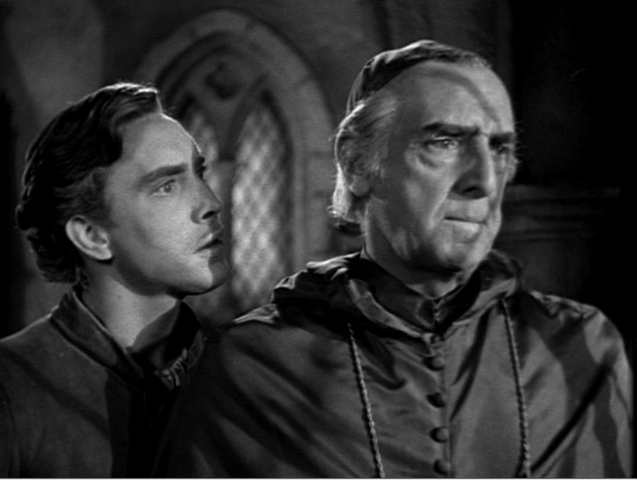

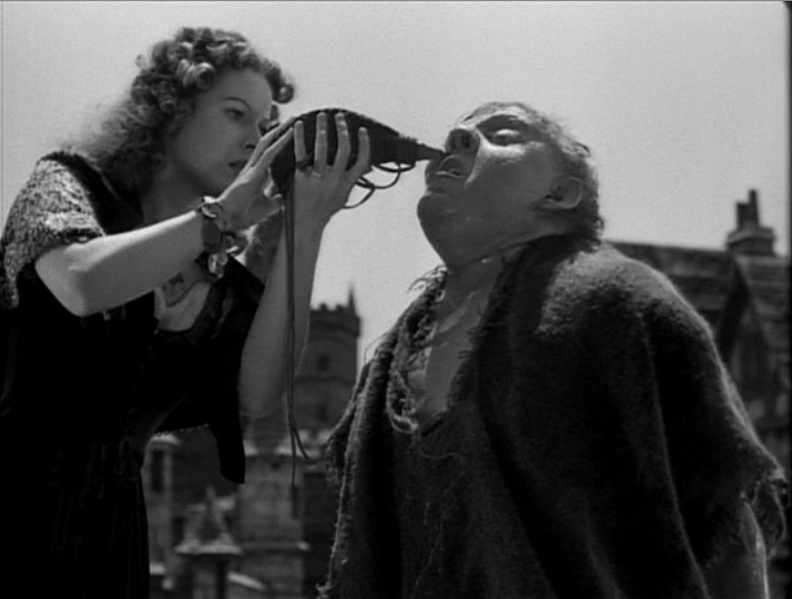
all these pictures are all from the “pillory scene” and now for the trial


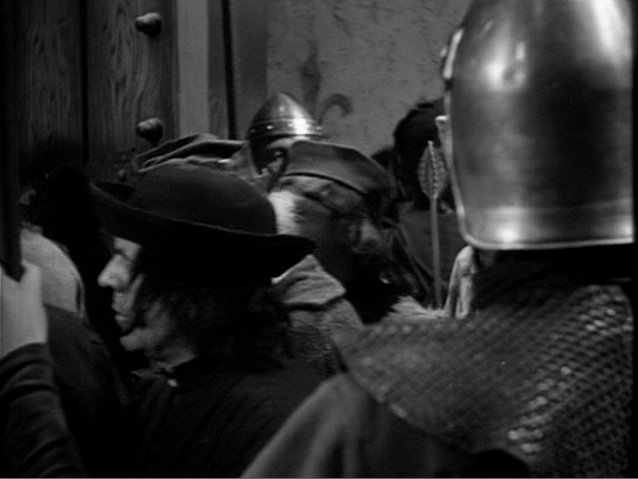


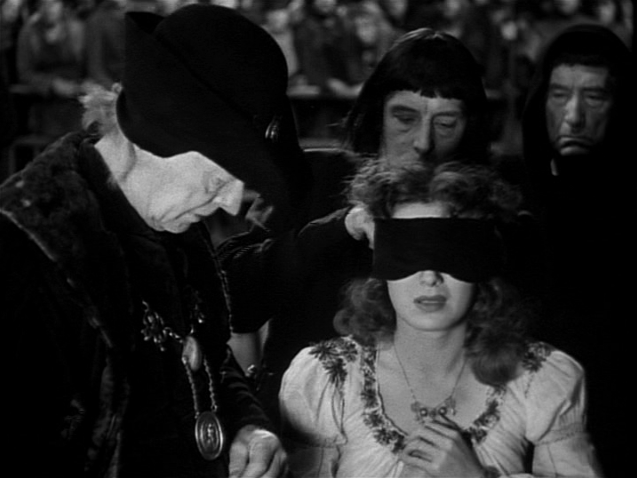
this scene does not have as many ADD-ons as the pillory scene but when Quasimodo comes in it just falls apart and having Louis there makes it worst.
Another big problem is Frollo’s obsession/lust for Esmeralda comes off very contrived. He sees her dance, he stares but I don’t think he is enchanted by her at that moment. Their discussion in Notre Dame is just there so he can talk to her. He starts by letting his prejudices and superstition about her and her people be known and thne he stares at her breasts for more than a few seconds. And while that part is quite amusing, it seems so forced, it almost like he bored of talking to her. After that the talk takes a dive because they strike an accord over a mutual love of animals, for no explain reason Frollo keeps a dozen cats in his office, I guess this would explain why he took in Quasimodo in the first place. Anyway it seemed that Frollo and Esmeralda could be have friends if Quasimodo haven’t scared her and he tried to kidnap her. A side point about the kidnapping, at the point where Esmeralda fled from Notre Dame she apparently lived in sanctuary because she didn’t have a city permit and would be arrested for not having one, so seemed like the “kidnapping” was only to take her back to safety. It’s good thing the guard who recused her didn’t ask for her permit, actually the permit thing is never mention again, it completed its’ mission for the plot. Anyway back to the Frollo/Esmeralda dynamic, given his tepid feeling and her lacking of feeling anything towards him, this makes the confession scene odd. Esmeralda and Gringoire are performing and for some weird reason Frollo is hosting. He asks Gringoire if he is ready to perform. When Gringoire is out the way , Frollo makes his move and confesses his confused little feelings. Now prior to this scene Frollo tried exactly once to find Esmeralda, he had all the Gypsy girls in the Court of Miracle arrested and then released because Esmeralda wasn’t there. So he didn’t shown his powerful obsession/lust, so it hard to buy his torment. Prior to this we know that Esmeralda doesn’t have any strong dislike of Frollo, so I don’t buy her fear in this scene either. Then she goes off with Phoebus and Frollo kills him again I don’t believe he was pushed to murder. Since Frollo is the catalyst that causes the story to take motion, the Frollo/Esmeralda dynamic needs to strong, not there because the it was in the original.
I do like that the theme is old vs new and embraces the sprit of progress, it’s a nice change of pace for a Hunchback movie. The cliche theme for Hunchback films is “beauty is on the inside”. But the theme does tries to hard it assert itself and competes with original too much. I think the plot suffers because of this and ultimately the the plot and the screenplay are the weakest element of the film.
Next time we’ll look at the Mise-en-scene for the movie. see ya then!
