
This performance of Belle confuses me. We have no Phoebus but whatever this isn’t the first performance to cast aside Phoebus. We have three languages being sung; French, Turkish and English. And what is Esmeralda wearing? It looks like a Grecian style maxi dress. I could expect this is Quasimodo and Frollo were not in period-ish style costumes. Maybe I’m missing something. Oh well, at least it’s not red. But also why does she seem angry? Also is just me or is Quasimodo’s prosthetic falling off?


Robert Hirsch as Gringoire, 1956 Hunchback of Notre dame
Gringoire is another character that can be a lot of different things pending on the needs of the version. He can be the hero, comic relief, narrator or a useless poet.
The 1956 version of Gringoire is the useless poet variety. That’s not to say he isn’t enjoyable. He gets a few funny lines but not enough to say he is the comic relief.

Robert Hirsch as Gringoire, 1956 Hunchback of Notre dame
So what does this Gringoire do in this version? Well, this Gringoire pretty much acts like he does in the book. He write a play that no cares about, he knows Frollo, he is smitten with Esmeralda, he almost gets hanged and marries her but doesn’t push the relationship and is just happy that she knows his name. He does want to help save Esmeralda for the removal of sanctuary but he told to stay behind and so he writes instead. And we never see again.
His character gets no resolution. I mean did he write that poem of the Court of Miracle’s victory with Jean as the hero? We’ll never know and I guess that makes him tragic.

Robert Hirsch as Gringoire, Alain Cuny as Phoebus, & Gina Lollobrigida as Esmeralda, 1956 Hunchback of Notre dame
All kidding a side, Gringoire’s depiction in this may keep to book with exception of the ending as he is not tricked by Frollo and doesn’t runs off with Djali but as he doesn’t do much that for the main plot we can’t connect with him.
He’s just a guy who goes with the flow, likes to write and hangs out with pretty ladies and goat. Maybe if we saw his reactions to Esmeralda’s death or if we saw him react to any of the drama it would have added to his character. So Gringoire is dull but he’s few silly lines make him slightly enjoyable.
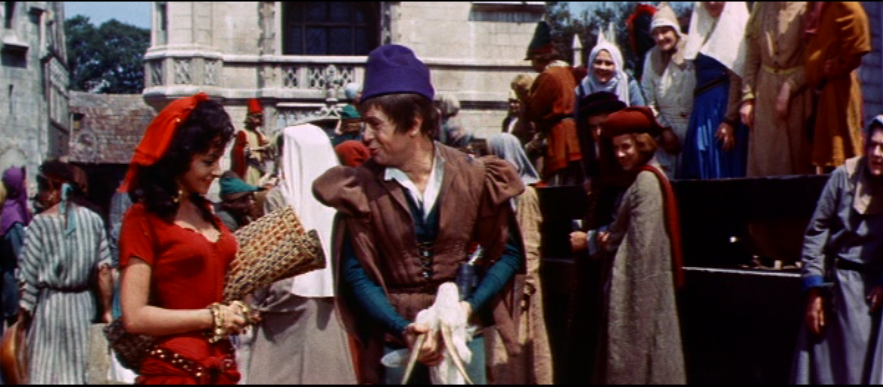
Robert Hirsch as Gringoire & Gina Lollobrigida as Esmeralda, 1956 Hunchback of Notre dame
Next 1956 Article; Clopin

Philippe Clay as Clopin, 1956 Hunchback of Notre dame

-

- Dancers, Notre Dame de Paris, Asian Tour
-

- Dennis Ten Vergert as Gringoire with a Dancer, Notre Dame de Paris, Asian Tour
-

- Dancers, Notre Dame de Paris, Asian Tour
-

- Stephen Webb as Phoebus with a Dancer, Notre Dame de Paris, Asian Tour
-

- Dennis Ten Vergert as Gringoire with a Dancer, Notre Dame de Paris, Asian Tour
-

- Candice Parise as Esmeralda, Stephen Webb as Phoebus with Dancers, Notre Dame de Paris, Asian Tour
-

- Robert Marien as Frollo & Candice Parise as Esmeralda, Notre Dame de Paris, Asian Tour
-

- Lilly -Jane Young as Fleur de Lys & Stephen Webb as Phoebus, Notre Dame de Paris, Asian Tour
-

- Matt Laurent as Quasimod & Candice Parise as Esmeralda, Notre Dame de Paris, Asian Tour
Some background; When I was sorting out the pictures from the Asian Tour I decided to make a sexy/romantic folder which I put into folder 20. It’s an accident that this folder coincides with Valentine’s day, but it seems appropriate doesn’t it?

Frollo (Alain Cuny), 1956 The Hunchback of Notre Dame
Frollo is the one of the major players in the story as he is the one who gets the story moving. In a way a Hunchback version needs a Frollo that the audience can enjoy whether he is just a dark and twisted man or a tortured priest who is in conflict with his heart and his mind.
So how does the 1956 version hold up?

Frollo (Alain Cuny) practices alchemy, 1956 The Hunchback of Notre Dame
To the film’s credit this is the first time we see Frollo as a priest who practices alchemy and lusts after Esmeralda . Too bad he’s boring, I have seen pieces of toast more interesting than him. Much like this version’s depiction of Quasimodo, this Frollo fails.

Frollo (Alain Cuny), 1956 The Hunchback of Notre Dame
First off, his looks. It’s not Cuny is ideally handsome but he is WAY too handsome to play Frollo. Frollo, while he isn’t suppose to be old, he is suppose to look austere not rugged. It doesn’t help the story when Frollo and Phoebus look like they could be the same fashion show.

Quasimodo (Anthony Quinn) & Frollo (Alain Cuny), 1956 The Hunchback of Notre Dame
Now this Frollo marks the first time we see Frollo as he was must to be; a tortured, lusty priest who practices alchemy on the side. The way Frollo showcases his torment in this movie is by scowling, hiding behind walls, and burying his face in this hands.
On the whole we don’t connect with his torment for Esmeralda. We get a few scenes where glares at her but we never see him bear his soul like Frollo does in the 1939 version or in Disney version.

Frollo (Alain Cuny) and Esmeralda (Gina Lollobrigida), 1956 Hunchback of Notre Dame
The only scene that serve to show Frollo as a more than a pseudo tormented lusty priest is during Esmeralda’s trial where he sort of defends her without giving himself away as the real attacker. But he turns on her when she speaks of love and life.
Also Esmeralda says that during the trail he was the worst face of all so I guess that little scene didn’t have much of an impact the characters. But I guess it’s nice that they tried.

Frollo (Alain Cuny) and Esmeralda (Gina Lollobrigida), 1956 Hunchback of Notre Dame
Like I have said Frollo should have a scene where he bears his soul. Whether it’s directly to Esmeralda or to audience, that is where his drama culminates. Keeping bottle up like this Frollo does adds nothing. The only “soul bearing” this Frollo does is he tell Esmeralda that she is his as he tries to force himself on her.

Frollo (Alain Cuny), 1956 The Hunchback of Notre Dame
I feel rather cheated that this version has the right basis for Frollo but fails to make him interesting and engaging. The Jetlag version of Frollo has more interest than this one and that it is really saying something.
We really can’t feel any torment or conflict from this Frollo because I think the director doesn’t know how to convey it. So in the end we have a great set-up for Frollo but the execution fails to give the drama that the character is meant to bring to the story.
Next 1956 Article – Phoebus

Jean Danet as Phoebus, 1956 The Hunchback of Notre Dame
Still from the Crocus City performances in Moscow.
-

- Alessandra Ferrari as Esmeralda, Notre Dame de Paris World Tour Cast
-

- Yvan Pedneault as Phoebus, Notre Dame de Paris World Tour Cast
-

- Ian Carlyle as Clopin & Alessandra Ferrari as Esmeralda, Notre Dame de Paris World Tour Cast
-

- Richard Charest as Gringoire, Notre Dame de Paris World Tour Cast
-

- Matt Laurent as Quasimodo & Alessandra Ferrari as Esmeralda, Notre Dame de Paris World Tour Cast
-

- Matt Laurent as Quasimodo, Notre Dame de Paris World Tour Cast
-

- Robert Marien as Frollo, Notre Dame de Paris World Tour Cast
-

- Elicia MacKenzie as Fleur de Lys, Matt Laurent as Quasimodo & Alessandra Ferrari as Esmeralda, Notre Dame de Paris World Tour Cast

Quasimodo (Anthony Quinn), 1956 The Hunchback of Notre Dame
Gotta say the 1956 version of Quasimodo was quite a disappointment. For a version that works so hard to maintain the plot of the book it really failed with Quasimodo’s character.

Quasimodo (Anthony Quinn) & Frollo (Alain Cuny), 1956 The Hunchback of Notre Dame
First off this Quasimodo isn’t a Hunchback, he is a slouch-back. He stands up fairly straight. I’m not sure if was this was the director trying to make Quasimodo more human or Anthony Quinn being lazy. My guess this was the director’s decision and I don’t agree.
You can’t really have the Hunchback of Notre Dame without the Hunch. If the director wanted to humanize Quasimodo he could have done it with the make-up but I think he missed the point. The point of Quasimodo is he the most human character but he looks like a monster. Having him not have the hunch takes away a big part of his character instead of being deformed he is just ugly. Although in the pillory scene you do see a hunch, too bad it disappears when he puts his shirt back on.

Quasimodo (Anthony Quinn) giving flowers to Esmeralda (Gina Lollobrigida) 1956 The Hunchback of Notre Dame
That is not it though, Quasimodo’s personality is very watered down to point where I’m not quite sure if he has one. He makes comments about people being bad but he spends most of his time mumbling and giggling. He just comes off a childish but with zero charm or interest.
You don’t feel for him; his pain, his love, his despair, nothing. So when we get the the original ending to the book in a movie you can’t feel anything because you have sent two hours not feeling anything for the emotional core of the movie.

Quasimodo (Anthony Quinn) laying down next to Esmeralda (Gina Lollobrigida) 1956 The Hunchback of Notre Dame
The movie tries to make you feel for Quasimodo but due the performance you really can’t connect with this Quasimodo and that does weaken the second half of the movie. It’s like all the pieces are there to make an good Quasimodo but they don’t connect right and we’re left with a half-form Quasimodo.

Quasimodo (Anthony Quinn) on the Pillory 1956 The Hunchback of Notre Dame
The only good thing to come from this Quasimodo is after Esmeralda gives him water he says ‘beautiful” or “Belle” and that inspired one of the greatest Hunchback songs ever.

Quasimodo (Anthony Quinn) with a cat, 1956 The Hunchback of Notre Dame
Also why is Quasimodo holding a cat? What’s up with Hunchback versions instering cats into shots?
Next 1956 Article – Frollo

Frollo (Alain Cuny), 1956 The Hunchback of Notre Dame
